


YouTube SEO for Beginners: Get More Views Without Ads
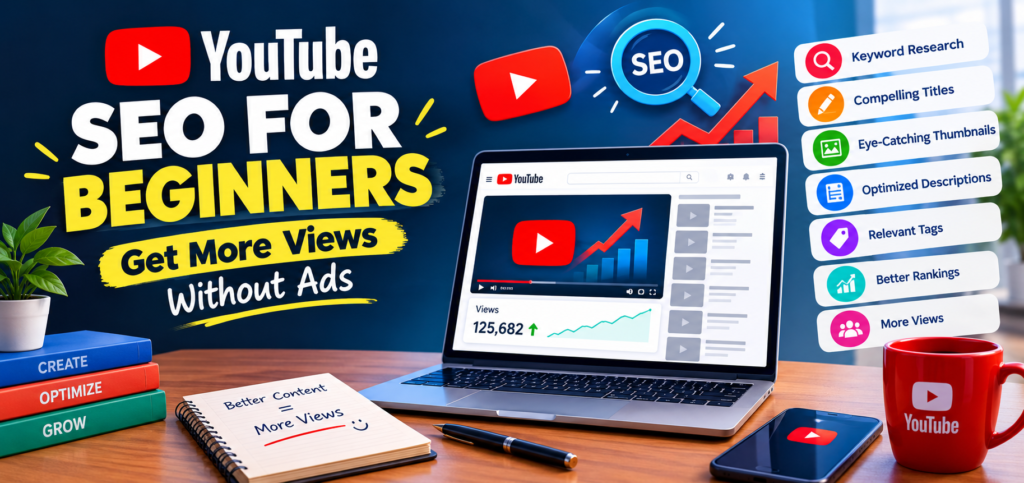
Getting views on YouTube without spending money on advertising is possible when you understand how YouTube SEO works. Instead of relying on paid promotion, creators can optimize their videos so YouTube understands the content, matches it with relevant viewers, and has more opportunities to recommend it.
YouTube SEO is not simply about adding keywords to a title. It involves choosing topics people actually search for, creating useful content, optimizing titles and thumbnails, improving viewer retention, and giving YouTube enough information to understand who should see your video.
If you’re starting with a small or brand-new channel, the strategies below can help you build organic visibility and gradually increase your views.
What Is YouTube SEO?
YouTube SEO is the process of optimizing your channel and videos to improve their visibility in YouTube search results, recommendations, and other discovery areas.
When someone searches for a topic on YouTube, the platform evaluates numerous signals to determine which videos may be most useful to that viewer. Relevance, engagement, viewer satisfaction, and the overall performance of a video can influence its visibility.
For beginners, the goal should not be to manipulate the algorithm. Instead, focus on creating videos that clearly satisfy the search intent of your target audience.
Why YouTube SEO Matters for Beginners
New channels usually don’t have a large subscriber base or an established audience. SEO can help overcome this challenge by allowing videos to reach people who are actively interested in specific topics.
A well-optimized video can potentially receive views days, weeks, or even months after publication. This makes organic YouTube traffic different from paid advertising, where visibility generally stops when the advertising budget ends.
Good YouTube SEO can help you:
- Reach viewers searching for your topic
- Discover relevant content ideas
- Improve your video’s visibility
- Attract viewers who are interested in your niche
- Increase organic traffic over time
- Build a more targeted audience
Start With YouTube Keyword Research
Keyword research is one of the most important steps in YouTube SEO.
Before creating a video, find out what your potential audience is searching for. Instead of targeting extremely broad keywords such as “fitness,” “marketing,” or “technology,” beginners should consider more specific phrases.
For example, instead of targeting:
YouTube SEO
you could target:
YouTube SEO for beginners
Or instead of:
YouTube Shorts
consider:
How to get more views on YouTube Shorts
Long-tail keywords usually provide clearer search intent and can make it easier to create highly relevant content.
Find Keywords Based on Search Intent
Search intent describes what a person wants when they enter a query.
Common types include:
- Informational: “How does YouTube SEO work?”
- Tutorial: “How to create a YouTube thumbnail”
- Comparison: “YouTube Shorts vs long videos”
- Problem-solving: “Why are my YouTube videos getting no views?”
- Commercial: “Best YouTube keyword research tools”
Understanding intent helps you create content that actually answers the viewer’s question.
Create Videos Around One Main Topic
A common mistake beginners make is trying to cover too many unrelated topics in one video.
Instead, choose one primary subject and build the video around it.
For example, a video titled “How to Get More YouTube Views” should primarily explain strategies for increasing views. Avoid filling it with unrelated information about Instagram, Facebook, or website SEO.
A focused topic makes your content easier for both viewers and YouTube to understand.
Optimize Your YouTube Video Title
Your title is one of the first things viewers see. It should communicate the video’s value while naturally incorporating your target keyword.
A strong title should be:
- Relevant to the actual video
- Easy to understand
- Specific
- Compelling
- Naturally optimized for search
For example:
Weak:
“Some YouTube Tips”
Better:
“7 YouTube SEO Tips to Get More Views in 2026”
The second title immediately tells viewers what they will learn.
Avoid misleading clickbait. A title may attract clicks initially, but if viewers quickly leave because the video doesn’t deliver what was promised, that can hurt the video’s overall performance.
Write Better YouTube Descriptions
Your video description provides additional context about your content.
Use the first few lines to clearly explain what the video is about. Include your primary keyword naturally and mention closely related terms where appropriate.
For example, if your target topic is YouTube SEO for beginners, your description could naturally discuss:
- YouTube SEO
- YouTube keyword research
- Video optimization
- YouTube rankings
- Getting organic views
Don’t repeatedly stuff the same keyword into your description. Write for humans first.
Use Relevant YouTube Tags
Tags can provide additional context about your video, but beginners shouldn’t treat tags as the most important part of YouTube SEO.
Use relevant variations and common misspellings when appropriate, but don’t fill your tag field with unrelated popular keywords.
Your title, topic, description, thumbnail, and actual video content should work together to communicate what your video is about.
Create Thumbnails That Earn Clicks
SEO can help people discover your video, but your thumbnail can determine whether they decide to click.
A strong thumbnail should communicate the video’s value quickly.
Consider using:
- A simple visual concept
- Large, readable text
- Strong contrast
- A clear subject
- An emotional or curiosity-driven element
- Consistent branding
Avoid overcrowding your thumbnail with paragraphs of text.
For example, a tutorial about increasing YouTube views could use a simple visual showing a rising view count with short text such as:
“MORE VIEWS?”
The thumbnail should complement the title rather than simply repeat it.
Focus on Audience Retention
Getting someone to click is only the beginning.
If viewers leave after a few seconds, your video may struggle to generate sustained performance.
Your introduction should quickly establish:
- What the video is about
- Why the viewer should continue watching
- What information they will receive
Avoid spending the first minute on lengthy introductions.
Instead of saying:
“Hi everyone, welcome back to my channel. Before we start today’s video…”
consider immediately addressing the viewer’s problem.
For example:
“If your YouTube videos are getting impressions but almost no views, these five SEO changes can help improve your click-through rate and audience retention.”
That gives the viewer a clear reason to continue.
Make Your Content More Valuable Than Your Competitors
SEO can help your video get discovered, but useful content gives viewers a reason to stay.
Before creating a video, examine existing content around your target keyword. Look for gaps.
Ask yourself:
- What questions aren’t being answered?
- Is the existing information outdated?
- Can I explain the topic more clearly?
- Can I provide examples?
- Can I make the tutorial easier to follow?
- Can I provide a better structure?
Don’t simply copy competitors. Use existing content as research and create something genuinely more useful.
Use YouTube Analytics to Improve Your SEO
YouTube Analytics can help you understand how viewers discover and interact with your videos.
Pay attention to metrics such as:
- Impressions
- Click-through rate
- Views
- Watch time
- Average view duration
- Audience retention
- Traffic sources
- Returning viewers
For example, if a video receives many impressions but relatively few clicks, your title or thumbnail may need improvement.
If people click but leave quickly, the issue may be your introduction, pacing, or content relevance.
Analytics turns YouTube SEO from guesswork into an ongoing optimization process.
Improve Videos That Are Already Published
You don’t always need to publish a completely new video to improve your channel.
Review older videos and identify opportunities to improve their:
- Titles
- Thumbnails
- Descriptions
- Content structure
- Keyword targeting
If an older video contains useful information but has a weak title or thumbnail, improving its presentation may give it another opportunity to attract viewers.
However, avoid constantly changing everything without analyzing performance. Make changes based on a clear reason and then monitor the results.
Use YouTube Shorts for Additional Discovery
YouTube Shorts can be useful for reaching viewers who prefer short-form content.
You can create Shorts from ideas related to your longer videos.
For example, if your main video is:
“Complete YouTube SEO Guide for Beginners”
you could create Shorts covering individual tips such as:
- One YouTube title mistake
- A quick keyword research tip
- A thumbnail mistake
- One way to improve audience retention
Short-form content can introduce your channel to new viewers and potentially encourage interested people to explore your longer videos.
Build Topic Clusters Around Your Niche
Instead of publishing completely unrelated videos, create multiple pieces of content around related topics.
For a YouTube SEO channel, a content cluster could include:
- YouTube SEO for beginners
- YouTube keyword research
- How to write YouTube titles
- YouTube thumbnail optimization
- YouTube Shorts SEO
- How to improve audience retention
- YouTube Analytics for beginners
- How to find low-competition keywords
This approach helps you build topical depth and gives viewers multiple relevant videos to watch.
Avoid Common YouTube SEO Mistakes
Beginners often make SEO more complicated than it needs to be.
Here are some mistakes to avoid.
Keyword Stuffing
Repeating the same keyword unnaturally doesn’t make your content better. Use keywords where they make sense.
Misleading Titles
Don’t promise something your video doesn’t deliver. A high click-through rate isn’t useful if viewers immediately leave.
Copying Competitors
Researching competitors is useful, but copying their titles, scripts, thumbnails, or entire content strategy won’t create a sustainable channel.
Ignoring Thumbnails
Even an excellent video can struggle if its packaging doesn’t encourage viewers to click.
Publishing Without a Strategy
Uploading random videos makes it difficult to understand what your audience actually wants.
Chasing Every Trend
Trends can produce temporary traffic, but building content around your niche can create more sustainable growth.
A Simple YouTube SEO Workflow for Beginners
If you’re new to YouTube SEO, follow this simple process for every video:
Step 1: Choose a specific topic
Find a problem, question, or subject your target audience cares about.
Step 2: Research keywords
Identify the phrases viewers might use when searching for that topic.
Step 3: Analyze existing videos
Look at competing content and identify opportunities to create something more useful.
Step 4: Create a strong title
Use the primary keyword naturally while communicating a clear benefit.
Step 5: Design an attractive thumbnail
Make the video’s value understandable at a glance.
Step 6: Create a strong introduction
Give viewers a reason to keep watching immediately.
Step 7: Optimize the description
Clearly explain what your video covers and naturally include relevant terminology.
Step 8: Publish consistently
Create a realistic schedule you can maintain instead of uploading excessively and burning out.
Step 9: Analyze performance
Review your analytics and identify what worked and what needs improvement.
Step 10: Improve your strategy
Use the data from previous videos to make better decisions for future content.
How Long Does YouTube SEO Take to Work?
There isn’t a fixed amount of time required for YouTube SEO to produce results.
Some videos can attract viewers shortly after publication, while others may take weeks or months to gain significant organic traffic.
Results can depend on factors such as:
- Search demand
- Competition
- Topic relevance
- Video quality
- Audience retention
- Click-through rate
- Channel history
- Viewer satisfaction
- Consistency
Therefore, don’t judge your entire channel based on the performance of one or two videos.
Can You Get YouTube Views Without Ads?
Yes. Paid advertising is not required to build a YouTube channel.
Organic discovery can come from YouTube Search, recommendations, Shorts, browse features, external sources, and viewers sharing your content.
The key is to create videos that people genuinely want to watch and make it easy for YouTube to understand who those videos are for.
Instead of paying for every view, focus on building an asset that can continue attracting viewers organically.
Final Thoughts
YouTube SEO for beginners doesn’t have to be complicated. Start with specific topics, research relevant keywords, create useful videos, optimize your titles and thumbnails, and pay attention to audience retention.
Most importantly, remember that SEO is only one part of YouTube growth. A keyword may help someone discover your video, but valuable content is what gives them a reason to watch, subscribe, and return.
If you consistently combine keyword research, strong titles, compelling thumbnails, useful content, audience retention, and analytics, you can build organic YouTube traffic without depending on paid ads.
The goal isn’t simply to get more clicks. The goal is to attract the right viewers and give them a reason to keep watching.