

How to Make Money With a Faceless YouTube Channel
A faceless YouTube channel can be a powerful way to build an online audience and generate income without appearing on camera. Instead of relying on your personality or physical presence, faceless channels use voiceovers, screen recordings, animations, stock footage, tutorials, storytelling, presentations, or other visual formats to deliver valuable content.
The opportunity is attractive in 2026 because creators have access to affordable editing software, AI-assisted production tools, and multiple ways to monetize an audience. However, building a profitable channel still requires original ideas, consistent publishing, strong audience retention, and content that provides genuine value.
This guide explains how to make money with a faceless YouTube channel, from choosing a profitable niche to creating content and developing multiple revenue streams.
What Is a Faceless YouTube Channel?
A faceless YouTube channel is a channel where the creator does not need to appear on camera. The content can be produced using narration, screen recordings, animation, graphics, demonstrations, interviews, gameplay, or carefully selected visual material.
For example, a creator could run a technology channel using screen recordings and voiceover instead of showing their face. Similarly, a finance education channel could use charts, animations, and narration to explain financial concepts.
The key advantage is flexibility. You can build a recognizable brand around the content and information rather than your personal appearance.
Can You Make Money With a Faceless YouTube Channel?
Yes, a faceless YouTube channel can generate income, but there is no guaranteed amount of money or guaranteed timeline.
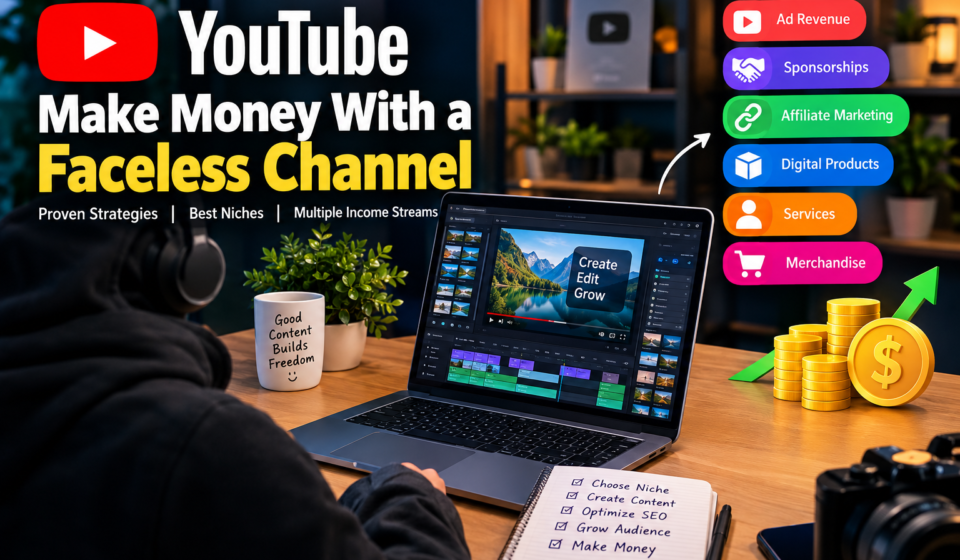
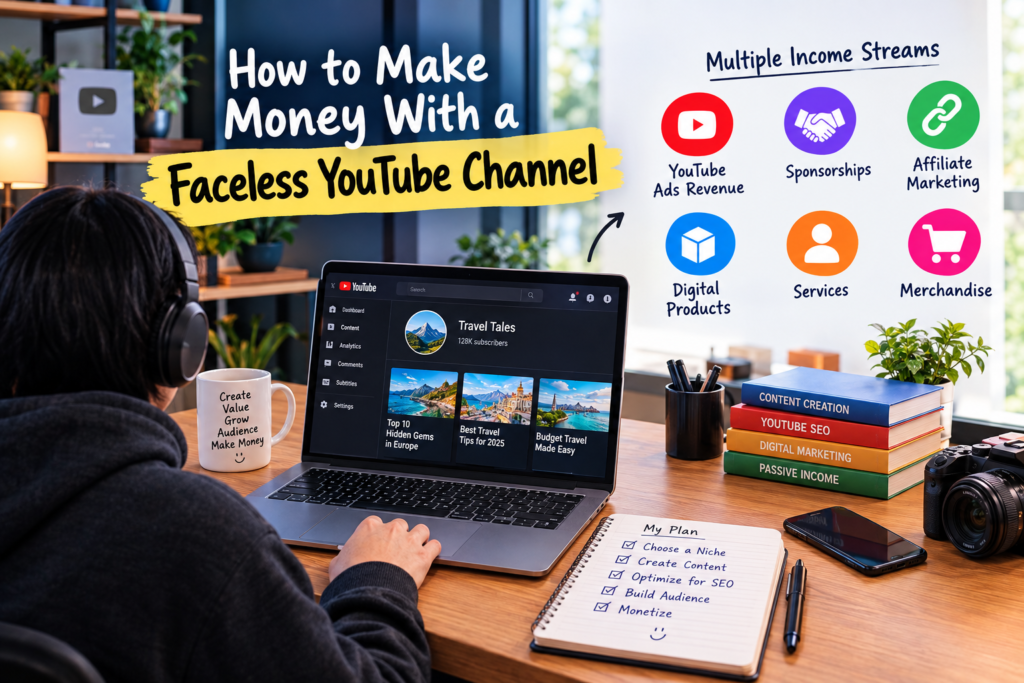
Successful channels can potentially earn through:
- YouTube advertising revenue
- Affiliate marketing
- Sponsorships
- Digital products
- Online courses
- Memberships
- Services
- Merchandise
- Lead generation
Your income will depend on factors such as your niche, audience location, views, watch time, engagement, monetization eligibility, advertiser demand, and the products or services you promote.
A channel with a smaller but highly targeted audience can sometimes have more commercial value than a large channel with an audience that rarely purchases anything.
Choose a Profitable Faceless YouTube Niche
Choosing the right niche is one of the most important decisions you will make.
Rather than choosing a topic simply because it is popular, look for a combination of audience demand, content opportunities, monetization potential, and your ability to produce useful content consistently.
Some faceless channel niches worth researching include:
1. Technology
Technology provides countless content opportunities. You can create:
- Software tutorials
- AI tool tutorials
- App reviews
- Productivity tools
- Software comparisons
- Tech tips
- How-to guides
Screen recordings make this niche particularly suitable for faceless creators.
2. Personal Finance Education
Finance-related content can attract commercially valuable audiences, although accuracy and responsible presentation are extremely important.
Potential topics include:
- Budgeting
- Saving strategies
- Investing education
- Personal finance tools
- Financial terminology
- Money-management tutorials
Avoid presenting financial information as personalized professional advice unless you have the appropriate qualifications and context.
3. Education
Educational channels can explain complicated subjects in simple ways.
Examples include:
- History
- Science
- Language learning
- Mathematics
- Career skills
- Study techniques
- Software education
Animation, diagrams, screen recordings, and narration can make educational videos engaging without requiring an on-camera presenter.
4. Software and AI Tutorials
AI and software tutorials are particularly suitable for faceless channels because much of the content can be demonstrated directly on screen.
You could create videos about:
- AI productivity tools
- Writing software
- Video editing applications
- SEO tools
- Website builders
- Design platforms
- Automation workflows
The most important factor is demonstrating something genuinely useful rather than simply producing generic AI-generated content.
5. Storytelling
Storytelling channels can use narration combined with illustrations, animation, graphics, or licensed footage.
Possible formats include:
- Historical stories
- Business stories
- Educational stories
- Mystery storytelling
- Biographical content
- Interesting facts
Research and originality are essential, particularly when discussing real people or historical events.
Create Content That People Actually Want to Watch
A faceless channel doesn’t succeed simply because it doesn’t show the creator’s face.
The real question is:
Why should someone watch your video instead of thousands of alternatives?
Before creating a video, identify the problem, question, curiosity, or desired outcome behind the search.
For example, instead of creating a generic video called:
“AI Tools You Should Know”
you could create a more specific video such as:
“7 AI Tools That Save Hours of Work Every Week”
The second concept communicates a clearer benefit.
Use Strong YouTube Titles
Your title plays an important role in attracting viewers.
A good title should:
- Clearly communicate the topic
- Create curiosity without misleading viewers
- Include the primary keyword naturally
- Communicate a benefit when appropriate
- Be easy to understand
Avoid stuffing keywords into titles. Write for humans first while making the subject clear to search engines.
Create Clickable Thumbnails
Your thumbnail and title work together.
A strong thumbnail usually communicates one simple idea rather than attempting to explain the entire video.
Consider using:
- Large readable text
- Strong visual contrast
- One clear focal point
- Relevant images
- Simple compositions
- Visual curiosity
Avoid misleading thumbnails. A viewer who clicks because of an inaccurate promise may quickly leave, which can hurt the overall viewing experience.
Use Voiceovers Effectively
You don’t need to appear on camera, but your videos still need a compelling presentation.
You can use:
- Your own voice
- A professional voice actor
- Appropriate text-to-speech technology
If you use an AI voice, focus on natural pacing, pronunciation, emotion, and clarity. Robotic narration combined with generic visuals can make content difficult to watch.
A strong script is often more important than the voice itself.
Write Better Scripts
A useful faceless video script can follow a simple structure:
Hook → Problem → Value → Examples → Conclusion → Call to Action
The opening should quickly tell viewers why the video is worth watching.
For example:
“If you’re starting a YouTube channel without showing your face, these three mistakes could prevent your videos from getting traction.”
Then deliver the information promised by the introduction.
Don’t unnecessarily stretch a five-minute idea into a fifteen-minute video. Viewer satisfaction should come before artificial length.
Use AI as an Assistant, Not a Replacement for Originality
AI can make content production faster, but simply generating large quantities of generic videos is not a sustainable strategy.
AI can help with:
- Topic research
- Brainstorming
- Outlining
- Script organization
- Title ideas
- Thumbnail concepts
- Transcription
- Captions
- Editing assistance
However, you should add your own research, examples, analysis, demonstrations, storytelling, or perspective.
The goal should be better content, not simply more content.
Understand YouTube Monetization
YouTube offers several monetization options, but eligibility depends on YouTube’s current Partner Program requirements and the specific monetization feature.
Advertising is only one potential revenue source.
Once your channel develops an audience, you can potentially combine YouTube revenue with other business models.
Always check YouTube’s current official monetization policies before building your strategy around a particular threshold or feature.
Make Money Through Affiliate Marketing
Affiliate marketing can be particularly useful for faceless channels.
Suppose you operate a software tutorial channel. You could create useful tutorials about tools you genuinely use and, where permitted, provide affiliate links.
When viewers purchase through your qualifying link, you may receive a commission.
Potential affiliate categories include:
- Software
- Hosting
- Website tools
- Productivity applications
- Educational platforms
- Creator tools
- Digital services
The most important rule is to recommend products that genuinely fit the video’s subject and disclose affiliate relationships appropriately.
Earn Through Sponsorships
Brands may pay creators to feature their products or services.
You don’t necessarily need millions of subscribers to attract sponsors. A smaller channel with a highly relevant audience can be valuable to a company.
For example, a channel focused on video-editing tutorials may be attractive to companies selling:
- Editing software
- Microphones
- Creator equipment
- Stock media
- AI tools
Build audience trust before aggressively pursuing sponsorships. Your reputation is a long-term asset.
Sell Digital Products
Digital products can create another income stream.
Depending on your niche, you could potentially sell:
- Templates
- Ebooks
- Checklists
- Presets
- Notion templates
- Design resources
- Educational guides
- Spreadsheets
- Online courses
For example, a productivity channel could create a downloadable productivity template that solves a problem discussed in its videos.
This creates a natural connection between the content and the product.
Offer Services
Your YouTube channel can also function as a marketing channel for a service business.
For example, a faceless channel about SEO could generate leads for:
- SEO consulting
- Website optimization
- Keyword research
- Content strategy
- SEO audits
Likewise, a design channel could promote graphic-design services.
In this model, YouTube isn’t necessarily the product. It becomes a source of qualified potential customers.
Build Multiple Income Streams
Depending entirely on advertising can make your business vulnerable to changes in views, advertiser demand, or platform policies.
A stronger long-term model can combine several revenue sources.
For example:
YouTube Content → Audience → Email List → Affiliate Products + Digital Products + Services
This gives you more ways to monetize the same audience.
Avoid Reused and Low-Value Content
One of the biggest mistakes aspiring faceless creators make is assuming that faceless means automated.
There is an important difference.
Faceless content means you don’t appear on camera.
Low-value content means the viewer receives little original or useful value.
Simply combining stock footage, automatically generated narration, and copied information may not create a compelling channel.
Instead, add meaningful value through:
- Original research
- Personal analysis
- Demonstrations
- Unique storytelling
- Educational explanations
- Commentary
- Visual examples
- Practical solutions
Your objective should be to create content viewers would willingly watch even if they never knew who was behind the channel.
Be Careful With Copyright
Copyright is another major consideration for faceless creators.
Don’t assume that material found online is automatically free to use.
Before using footage, music, images, clips, or other assets, understand the relevant licensing terms.
Consider using:
- Original recordings
- Properly licensed stock footage
- Licensed music
- Your own graphics
- Public-domain material where applicable
- Assets with appropriate commercial-use permissions
Adding narration over someone else’s copyrighted content does not automatically give you unrestricted rights to use it.
Build a Consistent Publishing System
Consistency doesn’t necessarily mean uploading every day.
Instead, create a realistic publishing schedule you can maintain.
For example:
Week 1: Research and outline
Week 2: Script and record
Week 3: Edit and create thumbnail
Week 4: Publish, analyze, and improve
If you can produce one excellent video every week, that’s often more sustainable than attempting seven videos and burning out.
Study Your YouTube Analytics
Once videos begin receiving views, your analytics can tell you what is working.
Pay attention to metrics such as:
- Click-through rate
- Audience retention
- Watch time
- Average view duration
- Traffic sources
- Returning viewers
- Audience demographics
If viewers consistently leave during the introduction, your opening may need improvement.
If viewers click but don’t watch for long, your title or thumbnail may be creating expectations that the video doesn’t satisfy.
Use analytics as feedback rather than obsessing over a single metric.
Create a Content Cluster
Instead of publishing completely unrelated videos, create groups of content around connected topics.
For example, an AI YouTube channel could have:
Pillar Topic: AI Tools
Supporting videos:
- Best AI Writing Tools
- Best AI Video Generators
- AI Tools for Students
- AI Tools for Small Businesses
- AI Tools for YouTube Creators
- How to Use AI for Content Creation
This approach gives viewers more reasons to watch additional videos on your channel.
Focus on Search and Suggested Traffic
YouTube traffic can come from several sources.
Search-focused videos answer specific questions people are actively looking for.
Suggested and browse-focused videos can attract viewers through recommendations and the YouTube homepage.
A balanced strategy can include both:
Search Content:
“How to Edit YouTube Shorts on Mobile”
Discovery Content:
“7 YouTube Shorts Editing Tricks That Make Videos Look Better”
Search content can target specific problems, while discovery-oriented videos can create broader audience interest.
How Much Money Can a Faceless YouTube Channel Make?
There isn’t a universal income figure.
Two channels receiving the same number of views can earn significantly different amounts because revenue can vary based on:
- Niche
- Viewer location
- Video length
- Audience demographics
- Advertiser demand
- Seasonality
- Monetization eligibility
- Revenue source
For this reason, avoid online claims promising that a specific number of views automatically equals a specific income.
Instead, think about building an audience and business ecosystem around your content.
A Simple Faceless YouTube Business Model
Here’s a practical model you can follow:
Step 1: Choose a specific niche.
Step 2: Research audience problems and questions.
Step 3: Find topics with meaningful search or recommendation potential.
Step 4: Create original scripts.
Step 5: Produce high-quality voiceover and visuals.
Step 6: Create compelling but accurate thumbnails and titles.
Step 7: Publish consistently.
Step 8: Study analytics.
Step 9: Improve your weakest content elements.
Step 10: Add relevant monetization methods once you have an audience.
The goal isn’t to make one viral video. The goal is to build a repeatable system that produces useful content and gradually grows an audience.
Common Faceless YouTube Mistakes to Avoid
Choosing a Niche Only Because It Looks Profitable
A profitable niche is useless if you cannot consistently produce valuable content for it.
Copying Successful Channels
Study successful channels for ideas about formats and audience needs, but don’t simply reproduce their scripts, videos, branding, or concepts.
Publishing AI-Generated Content Without Editing
AI can accelerate production, but human review and originality remain important.
Ignoring Thumbnails
Even excellent content needs an effective way to attract viewers.
Focusing Only on Views
Views are useful, but an audience that trusts your content can be more valuable than random viral traffic.
Expecting Instant Income
Most channels require experimentation, publishing, and improvement before becoming meaningful businesses.
Final Thoughts
Learning how to make money with a faceless YouTube channel is less about finding a secret automation trick and more about building a valuable media business.
Choose a focused niche, research what your audience actually wants, create original and useful videos, improve your thumbnails and titles, study your analytics, and gradually develop multiple revenue streams.
You don’t need to show your face to build an audience. But you do need to give viewers a reason to click, watch, trust, and return.
With a consistent strategy and a long-term mindset, a faceless YouTube channel can become more than a collection of videos—it can become an audience-driven online business.