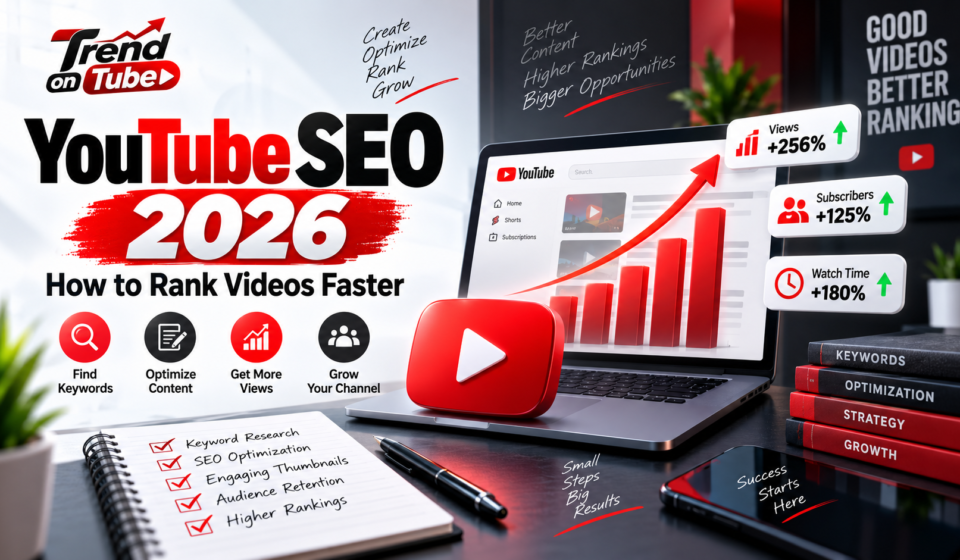

YouTube SEO 2026: How to Rank Videos Faster
Meta Description: Learn YouTube SEO 2026 strategies to rank videos faster, find low-competition keywords, boost views, and grow your channel organically.
If you’re creating great YouTube videos but struggling to get views, the problem may not be your content. Your videos might simply not be reaching the right audience.
That’s where YouTube SEO comes in.
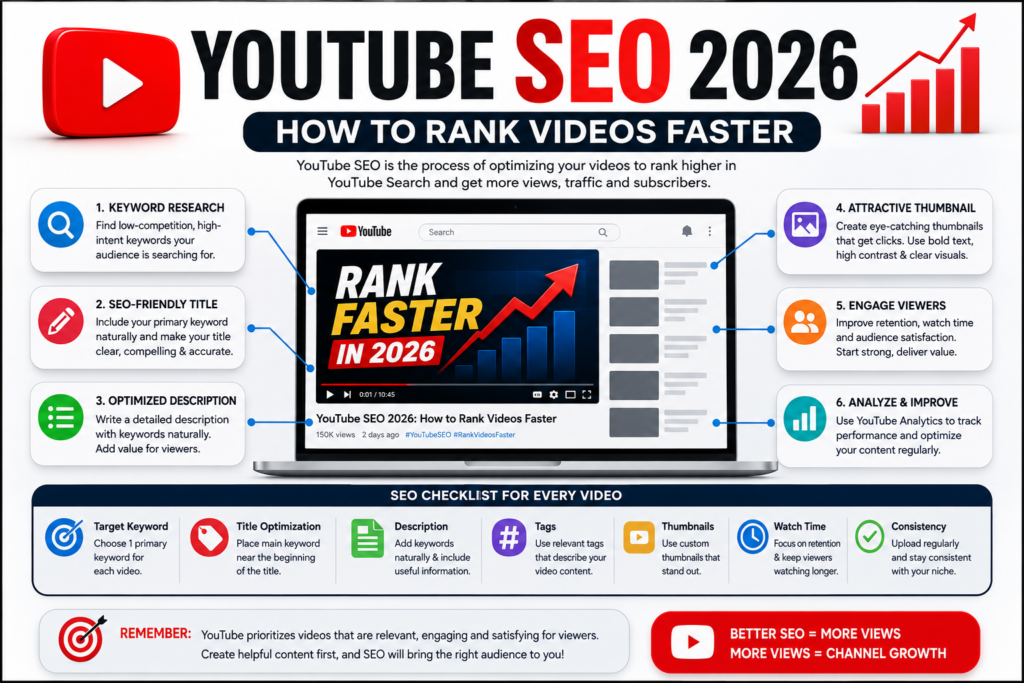
YouTube SEO is the process of optimizing your videos, titles, descriptions, topics, thumbnails, and overall content strategy so that YouTube can better understand your content and connect it with viewers who are interested in it.
In 2026, successful YouTube SEO is about much more than adding keywords to a title. You need to combine search intent, keyword research, compelling packaging, audience retention, engagement, and viewer satisfaction.
YouTube explains that Search primarily considers relevance, engagement, and quality. Its recommendation systems also look at how viewers respond to content and whether they continue watching and enjoy it.
So, how can you rank YouTube videos faster in 2026?
Let’s break it down.
What Is YouTube SEO?
YouTube SEO is the practice of optimizing your video content to improve its visibility in YouTube Search and other discovery surfaces.
When someone searches for a topic, YouTube tries to identify the videos that are most relevant and useful for that particular viewer. Its systems can consider signals such as the video’s title, description, tags, content, engagement, and watch time for a particular search.
However, SEO alone doesn’t guarantee rankings.
Your video also needs to satisfy viewers.
If people see your video but don’t click, leave quickly, or don’t find it useful, strong keyword optimization won’t magically make it successful.
That is why modern YouTube SEO should be approached as:
Keyword relevance + strong packaging + valuable content + viewer satisfaction.
How YouTube Search Ranking Works in 2026
Understanding how YouTube evaluates content is the first step toward creating an effective SEO strategy.
YouTube identifies three major elements for Search:
1. Relevance
YouTube determines how closely a video matches a viewer’s search query.
This can include the relationship between the search query and your:
- Video title
- Description
- Tags
- Video content
- Overall topic
For example, if someone searches for “YouTube SEO for beginners,” a video specifically explaining YouTube SEO for beginners is likely to be more relevant than a general video about becoming a content creator.
2. Engagement
YouTube also considers how viewers interact with content.
Watch time can help YouTube determine whether viewers consider a video relevant to a particular search. Recommendations also consider whether viewers choose to watch, continue watching, or indicate that they aren’t interested.
3. Quality
Quality matters because YouTube wants to provide useful and trustworthy results.
For certain topics, YouTube systems look for signals that indicate expertise, authoritativeness, and trustworthiness.
This means creating genuinely helpful content is not just good for your audience—it can also support discoverability.
10 Proven YouTube SEO Strategies for 2026
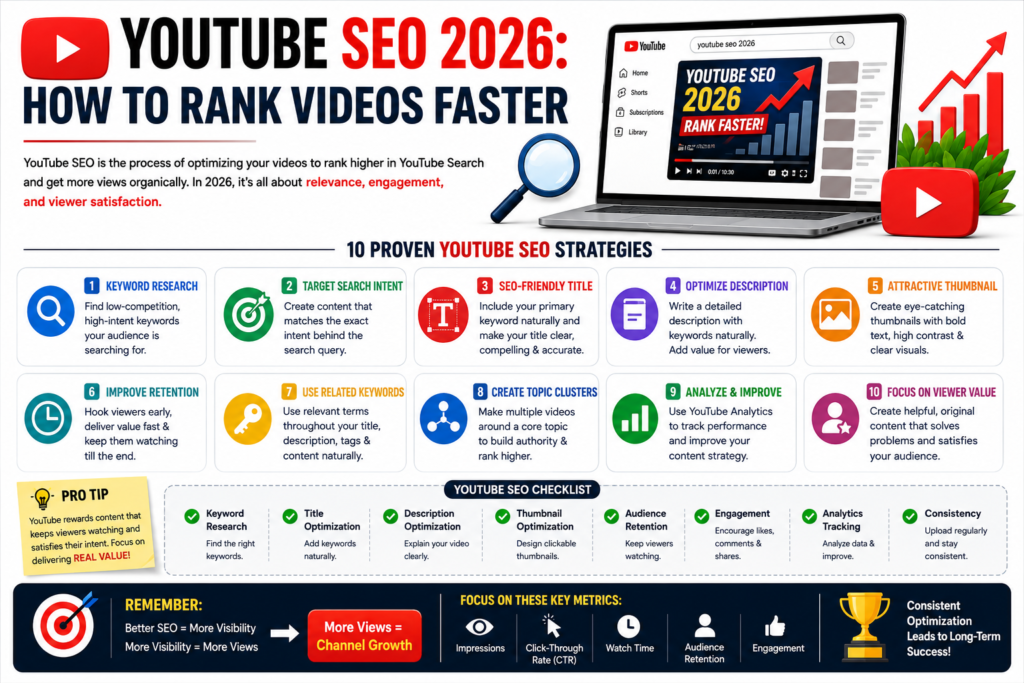
1. Start With YouTube Keyword Research
Before creating a video, find out what your target audience is actually searching for.
Instead of targeting an extremely broad keyword such as:
“YouTube SEO”
consider a more specific search phrase such as:
“YouTube SEO for small channels”
or:
“How to rank YouTube videos in 2026”
Long-tail keywords can make it easier to create highly focused content because they reveal a more specific search intent.
Your goal isn’t simply to find the keyword with the highest search volume.
Your goal is to find a keyword where:
Audience demand > Competition + Your channel’s ability to compete
Look for keywords that are:
- Relevant to your niche
- Specific
- Search-focused
- Connected to a clear problem
- Possible to answer better than existing results
Use YouTube’s Trends Tab
YouTube Studio’s Trends tab can provide valuable insights into what your audience and viewers across YouTube are searching for.
YouTube says the Trends tab includes information such as top searches, breakout videos, recent videos, and Shorts content gaps. It can also highlight content gaps where viewers aren’t finding enough relevant or high-quality results.
That makes it particularly useful for discovering content opportunities before producing your next video.
2. Target Search Intent, Not Just Keywords
A keyword tells you what someone searches for.
Search intent tells you why they searched for it.
For example:
“YouTube thumbnail size”
has informational intent.
The viewer probably wants a specific answer.
Meanwhile:
“best YouTube editing software”
could indicate commercial investigation because the viewer may be comparing tools.
Your video should satisfy the exact reason behind the search.
Ask:
What does the viewer want to accomplish after searching this keyword?
Then build your video around that answer.
3. Create SEO-Friendly YouTube Titles
Your title is one of the first things viewers see.
YouTube recommends creating titles that accurately represent the video and keeping them concise, with the most important words near the beginning. It also distinguishes between searchable titles and curiosity-driven titles.
A strong SEO title should:
- Include the primary keyword naturally
- Clearly communicate the video’s benefit
- Create enough curiosity to earn a click
- Accurately represent the content
- Avoid misleading claims
Weak Title
My YouTube Tips
Better SEO Title
YouTube SEO 2026: How to Rank Videos Faster
Another Option
How to Rank YouTube Videos Faster in 2026
The second versions immediately tell the viewer what the video is about.
4. Optimize Your Video Description
Your description provides additional context about your video.
Use the first few lines to clearly explain what viewers will learn.
Naturally include your primary keyword and related terms without stuffing them repeatedly.
For example, instead of writing:
YouTube SEO, YouTube SEO 2026, YouTube SEO tips, YouTube SEO ranking…
write naturally:
Learn how YouTube SEO works in 2026 and discover practical strategies for keyword research, titles, thumbnails, audience retention, and video optimization.
Your description should help both the viewer and YouTube understand the subject of your content.
Remember: YouTube says relevance can be estimated using information including the title, description, tags, and video content.
5. Don’t Ignore Your Thumbnail
A great title can attract attention, but the thumbnail has to work with it.
YouTube reports that 90% of its best-performing videos have custom thumbnails. It recommends thumbnails that are clear, representative of the content, and easy to understand across devices.
Your thumbnail should communicate one simple idea.
Instead of filling the thumbnail with text, try:
3–5 powerful words + one clear visual concept
For example:
RANK FASTER
could be more effective visually than:
HOW TO RANK YOUR YOUTUBE VIDEOS FASTER IN 2026
The title can provide the details while the thumbnail creates the visual hook.
6. Improve Audience Retention
Getting a click is only the beginning.
You need to give viewers a reason to continue watching.
YouTube says its systems use signals including average view duration and average percentage viewed when evaluating performance.
Start your video by delivering on the promise made by your title and thumbnail.
Avoid spending the first 30 seconds explaining who you are.
Instead:
Hook → Problem → Promise → Value
For example:
“If your YouTube videos are getting impressions but almost no views, three SEO mistakes could be holding your channel back. In this video, I’ll show you exactly what they are and how to fix them.”
Then get straight into the solution.
7. Use Related Keywords Naturally
Don’t optimize your video around only one phrase.
Build a small keyword cluster around the main topic.
For YouTube SEO 2026, related phrases could include:
- YouTube SEO
- YouTube SEO tips
- YouTube keyword research
- YouTube ranking
- YouTube algorithm
- YouTube video optimization
- YouTube search ranking
- YouTube keywords
- YouTube traffic
- YouTube channel growth
Use relevant terms naturally throughout your content, especially when they genuinely describe what you’re discussing.
The objective isn’t to repeat keywords.
The objective is to make the topic unmistakably clear.
8. Create Content That Solves a Specific Problem
One of the biggest mistakes creators make is trying to create videos for everyone.
Instead, create videos for a specific viewer.
Compare:
“YouTube Tips”
with:
“YouTube SEO for Small Channels: 7 Ranking Strategies”
The second topic has a clearly defined audience and problem.
It also gives you an opportunity to build topical authority.
Once you publish one useful video, create related videos around the same subject.
For example:
YouTube SEO Content Cluster
Pillar Video:
YouTube SEO 2026: How to Rank Videos Faster
Supporting Videos:
- How to Find Low Competition YouTube Keywords
- YouTube Keyword Research for Beginners
- How to Write YouTube Titles
- YouTube Thumbnail SEO Tips
- How to Increase YouTube CTR
- How to Improve YouTube Audience Retention
- YouTube Shorts SEO Guide
- YouTube Description SEO
- YouTube Analytics for Beginners
This creates a stronger content ecosystem around your niche.
9. Use YouTube Analytics to Improve Your SEO
Don’t publish a video and forget about it.
Use YouTube Analytics to understand how viewers are responding.
Pay attention to metrics such as:
- Impressions
- Click-through rate
- Average view duration
- Audience retention
- Watch time
- Traffic sources
- Returning viewers
YouTube recommends using Analytics to understand how audiences respond to titles and thumbnails and to identify content your viewers are interested in.
For example:
High impressions + low CTR
Your topic may have potential, but your title or thumbnail may not be convincing enough.
High CTR + low retention
People are clicking, but the video isn’t delivering quickly enough on the promise.
Low impressions + strong retention
The content may satisfy viewers who find it, but you may need to improve topic selection, relevance, packaging, or audience targeting.
Use the data to diagnose the problem instead of randomly changing everything.
10. Build Around Topics With Lower Competition
If you’re running a small or new channel, competing immediately for extremely broad keywords can be difficult.
Instead of:
“YouTube”
target:
“YouTube SEO for small channels”
Instead of:
“YouTube Shorts”
target:
“YouTube Shorts SEO for beginners”
Instead of:
“YouTube algorithm”
target:
“YouTube algorithm for small channels 2026”
This is a long-tail strategy.
You sacrifice some potential search volume in exchange for a more specific audience and a potentially more achievable competitive environment.
But don’t assume a keyword is low competition simply because it is long-tail.
Check the actual search results and compare:
- Number of competing videos
- Quality of existing videos
- Age of competing content
- Search intent match
- Channel authority
- Engagement
- Content quality
YouTube SEO Mistakes to Avoid in 2026
Keyword Stuffing
Repeating the same keyword dozens of times can make your content look unnatural.
Write for humans first.
Misleading Titles
Don’t promise something your video doesn’t deliver.
YouTube explicitly recommends accurate titles and thumbnails and warns against deceptive or misleading packaging.
Obsessing Over Tags
Tags aren’t the secret ranking factor many creators assume.
YouTube’s current guidance says tags can be useful, but they are not essential for discovery and are primarily useful for correcting common spelling mistakes.
Making Videos Only for Search Engines
A perfectly optimized title cannot save boring content.
YouTube’s recommendation system ultimately focuses on connecting viewers with content they’re likely to watch and enjoy.
Chasing Every Trend
A trending topic isn’t automatically a good topic for your channel.
Ask:
Does this trend fit my audience?
If not, the traffic may be temporary and may not produce valuable returning viewers.
YouTube SEO Checklist for 2026
Before publishing your next video, run through this checklist:
Keyword Research
- Primary keyword identified
- Search intent understood
- Competition reviewed
- Related keywords identified
- Topic relevant to your audience
Title
- Primary keyword appears naturally
- Main benefit is clear
- Important words appear early
- Title accurately represents the video
- No unnecessary keyword stuffing
Description
- Topic clearly explained
- Primary keyword used naturally
- Related terms included where relevant
- Helpful information provided
Thumbnail
- Custom thumbnail created
- Easy to understand
- Strong visual contrast
- Minimal text
- Accurately represents the video
Content
- Strong opening hook
- Delivers on the title’s promise
- Provides genuine value
- Maintains viewer interest
- Clear structure
- Strong conclusion or next step
Analytics
- CTR reviewed
- Audience retention reviewed
- Watch time analyzed
- Traffic sources checked
- Future content based on viewer data
The Fastest YouTube SEO Strategy for Small Channels
If you’re starting from scratch, don’t try to rank for everything.
Build a focused content strategy.
Step 1: Choose One Niche
For example:
YouTube Growth
Step 2: Select One Audience
Small YouTubers and beginners
Step 3: Find Long-Tail Topics
Examples:
- YouTube SEO for beginners
- YouTube SEO for small channels
- Low competition YouTube keywords
- YouTube Shorts SEO
- How to rank YouTube videos
- YouTube thumbnail tips
Step 4: Create Better Content Than Existing Results
Don’t simply copy what competitors are doing.
Find what their videos fail to explain and make your version more useful.
Step 5: Build Topic Clusters
Create multiple videos around related problems.
Step 6: Study Analytics
Identify which topics, thumbnails, titles, and formats generate the strongest response.
Step 7: Double Down on Winners
When a topic performs well, create related content rather than immediately jumping into an unrelated niche.
Does YouTube SEO Still Work in 2026?
Yes—but YouTube SEO should not be confused with simply inserting keywords into a title.
YouTube Search still uses relevance signals, while recommendations are strongly influenced by viewer behavior, personalization, performance, engagement, and satisfaction.
The biggest opportunity is to combine SEO with good content.
Think of YouTube growth as a system:
Topic → Keyword → Search Intent → Title → Thumbnail → Click → Retention → Satisfaction → More Discovery
If one part is weak, growth can slow down.
If the entire system works together, your video has a much better chance of reaching the right audience.
Final Thoughts
YouTube SEO in 2026 isn’t about discovering one magical keyword or tricking an algorithm.
It’s about making your content easy to understand, highly relevant to a specific audience, and genuinely worth watching.
Start with keyword research. Understand search intent. Create compelling but accurate titles. Design clear thumbnails. Deliver value quickly. Improve audience retention. Then use YouTube Analytics to learn what your viewers actually want.
Most importantly, don’t obsess over the algorithm.
YouTube itself recommends focusing on your audience because its systems are designed around helping viewers find videos they are likely to watch and enjoy.
The creators who win with YouTube SEO in 2026 won’t simply optimize for search engines—they’ll optimize the entire viewer experience.

[…] YouTube SEO Mistakes You Must […]