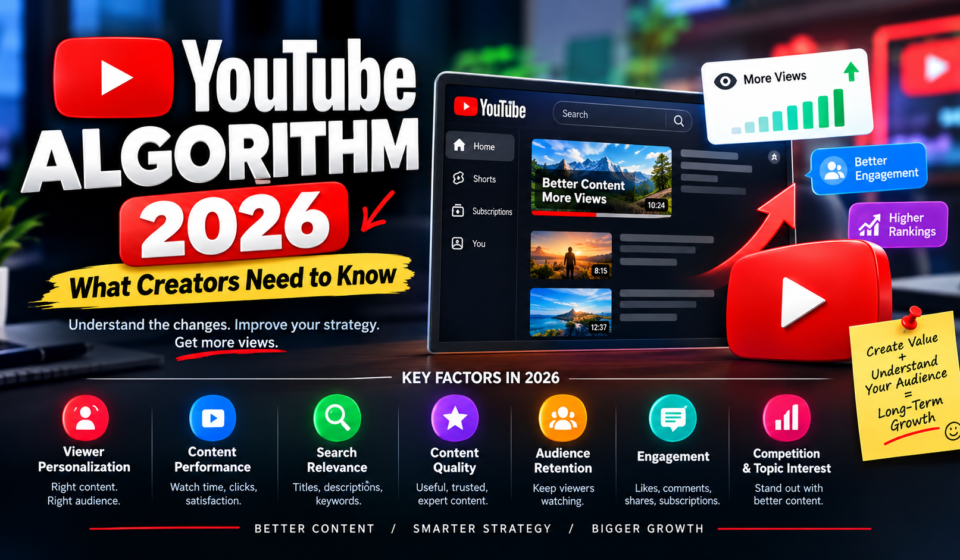

YouTube Algorithm 2026: What Creators Need to Know
Meta Description: Discover how the YouTube algorithm works in 2026, with proven tips to boost video visibility, engagement, rankings, and channel growth.
If you’re a YouTube creator, you’ve probably asked yourself the same question: How does the YouTube algorithm decide which videos get views?
The answer is more complicated than simply finding a trending keyword or getting a high number of likes.
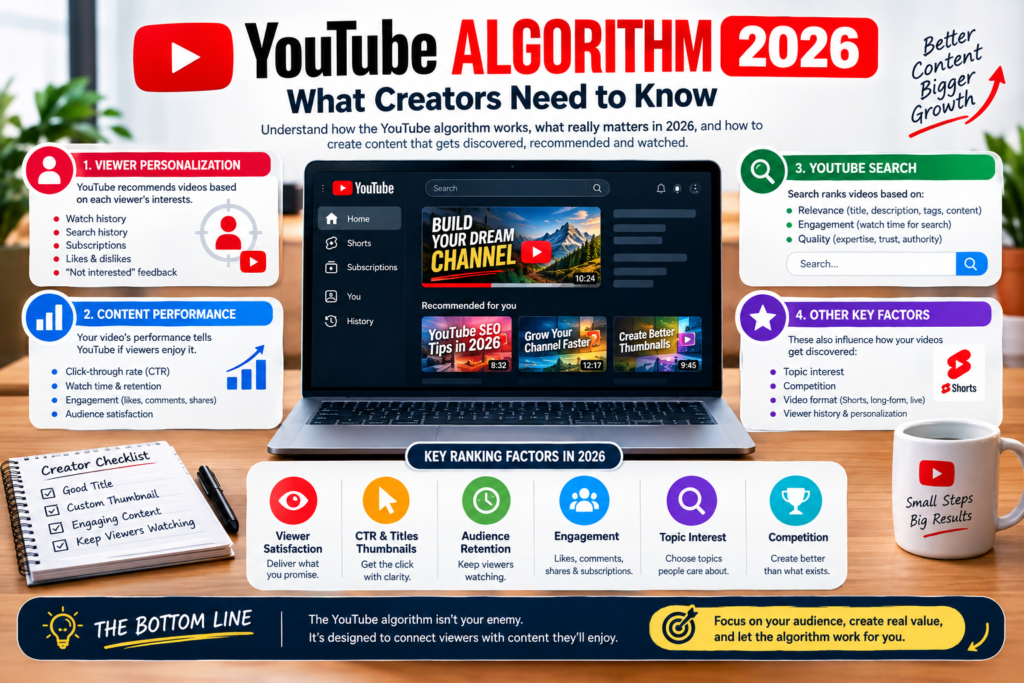
In 2026, YouTube’s recommendation and discovery systems are designed around a central goal: helping individual viewers find videos they are likely to watch and enjoy. YouTube explains that recommendations are personalized and influenced by viewer preferences, content performance, and other external factors.
That means there is no single “secret algorithm trick” that guarantees viral growth.
Instead, successful creators need to understand how viewer behavior, content quality, relevance, packaging, satisfaction, and competition work together.
This guide explains the YouTube algorithm in simple terms and shows you what creators should focus on in 2026.
What Is the YouTube Algorithm?
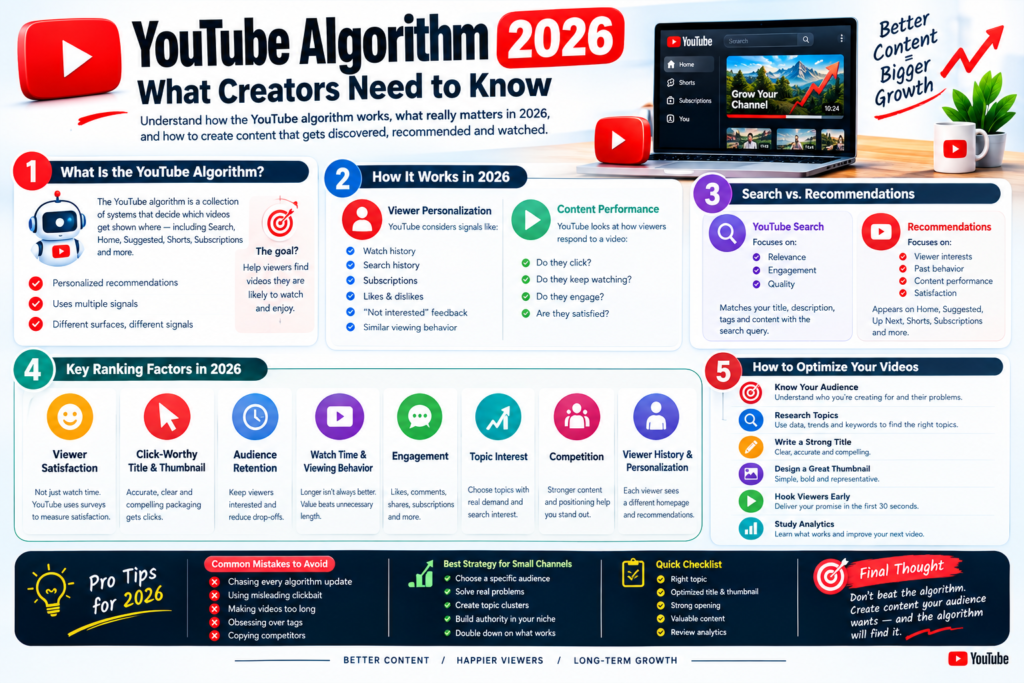
The phrase “YouTube algorithm” actually refers to a collection of systems that help determine which videos are shown to viewers across different parts of YouTube.
These include:
- YouTube Search
- Home page recommendations
- Suggested videos
- Up Next
- Shorts Feed
- Subscription-related surfaces
- Topic and destination pages
Each surface can use different signals because viewers behave differently depending on where they discover content. YouTube says its recommendation system is personalized and uses signals such as watch history, search history, subscriptions, likes, dislikes, and satisfaction feedback.
So, rather than thinking:
“How do I beat the YouTube algorithm?”
a better question is:
“How do I create videos that my target viewers genuinely want to watch?”
That shift in mindset is one of the most important YouTube growth strategies for 2026.
How the YouTube Algorithm Works in 2026
YouTube’s recommendation system essentially tries to predict what each viewer is most likely to enjoy.
According to YouTube, recommendations are influenced by two major categories:
1. Viewer Personalization
YouTube considers signals that help it understand an individual viewer’s interests.
These can include:
- Watch history
- Search history
- Subscriptions
- Likes
- Dislikes
- “Not interested” feedback
- “Don’t recommend channel” feedback
- Similar viewing behavior
The system uses these signals to personalize the videos shown to each person.
2. Content Performance
YouTube also evaluates how viewers respond when a video is shown to them.
For example:
- Do they choose to watch?
- Do they continue watching?
- Do they engage positively?
- Does the content satisfy their expectations?
YouTube describes recommendation performance as being strongly connected to whether viewers choose to watch and enjoy the content.
This is why creating content for a clearly defined audience is so important.
YouTube Algorithm vs. YouTube Search Algorithm
One common mistake is assuming that YouTube Search and recommendations work exactly the same way.
They don’t.
YouTube Search
When someone searches for something, YouTube’s search ranking system primarily considers:
- Relevance
- Engagement
- Quality
Relevance includes how well the title, description, tags, and actual video content match the viewer’s query. Engagement can include watch time for a particular search, while quality includes signals related to expertise, authoritativeness, and trustworthiness.
For example, someone searching for:
“how to create a YouTube thumbnail”
is intentionally looking for an answer.
Your video’s topic and metadata should clearly communicate that it provides that answer.
Recommendations
Recommendations are more personalized.
A viewer who watches videos about YouTube growth might receive completely different recommendations from someone who primarily watches gaming videos—even if both people are using YouTube at the same time.
YouTube says recommendations can appear on the Home page, Up Next, Shorts player, destination pages, and channel pages.
The Most Important YouTube Ranking Factors in 2026
There isn’t a single universal ranking-factor checklist that determines whether every video will succeed.
However, creators can focus on several important areas that directly influence discoverability and viewer response.
1. Viewer Satisfaction
One of the biggest lessons from YouTube’s current guidance is that viewer satisfaction matters—not just watch time.
YouTube says its recommendation system uses satisfaction surveys alongside other signals to understand whether viewers actually enjoyed the content.
A video can have a strong click-through rate but still fail to build long-term performance if viewers quickly realize that it doesn’t deliver what the title and thumbnail promised.
Your objective should therefore be:
Get the click → Deliver the promise → Provide value → Leave the viewer satisfied.
2. Click-Worthy Titles and Thumbnails
Your title and thumbnail are your video’s packaging.
Before someone watches your content, they have to decide whether your video is worth clicking.
YouTube recommends titles that accurately represent the content and thumbnails that clearly communicate what viewers can expect. It also says that 90% of its best-performing videos have custom thumbnails.
Example
Instead of:
YouTube Tips
try:
7 YouTube Algorithm Mistakes Killing Your Views
The second title gives viewers a specific reason to click.
However, don’t create misleading clickbait.
If the video doesn’t deliver what the title promises, viewers may leave quickly, which can hurt performance.
YouTube specifically advises creators to avoid deceptive, misleading, sensational, or inaccurate titles and thumbnails.
3. Audience Retention
Getting viewers to click is only the beginning.
You need to keep them interested.
Audience retention shows you where viewers continue watching and where they leave.
YouTube Analytics provides retention reports that help creators identify moments where viewers drop off, rewatch sections, or remain highly engaged.
A strong video structure can look like this:
Hook → Problem → Promise → Value → Examples → Conclusion
Avoid long introductions that delay the actual content.
If your title promises:
“5 YouTube SEO Mistakes You Must Avoid”
don’t spend the first minute talking about unrelated personal information.
Give viewers what they came for.
4. Watch Time and Viewing Behavior
Watch time remains an important performance metric, but it shouldn’t be treated as a magic number.
A longer video isn’t automatically better than a shorter video.
YouTube explicitly says there is no universal ideal video length. The appropriate length depends on the content, audience, and purpose. Creators should avoid artificially stretching videos and instead make them as long as necessary to deliver value effectively.
So don’t make a 20-minute video when the topic can be explained properly in eight minutes.
Value beats unnecessary length.
5. Engagement
Likes, comments, shares, subscriptions, and other interactions can provide useful signals about how viewers respond to content.
But creators shouldn’t focus on collecting engagement for its own sake.
Instead, create content that naturally encourages viewers to participate.
For example:
“Which YouTube SEO strategy has worked best for your channel? Tell us in the comments.”
The question should be relevant to the video rather than an artificial attempt to generate comments.
6. Topic Interest
Even excellent videos can struggle when there isn’t much audience interest in the topic.
YouTube explains that topic interest influences how many potential viewers exist for a subject. Some topics naturally attract larger audiences than others.
Before creating a video, ask:
- Are people interested in this topic?
- Is the topic growing?
- Does it solve a real problem?
- Does my audience care about it?
- Is there a current event or trend increasing interest?
This can help you choose stronger topics before investing hours into production.
7. Competition
You aren’t competing only against videos in your niche.
YouTube says its systems rank your content against all the videos a viewer might want to watch. Even if your video performs well by your own channel’s standards, stronger competing content can affect the number of impressions you receive.
This is why content quality and positioning matter.
If you’re a small channel, competing for a massive keyword like:
“YouTube”
is unlikely to be the smartest strategy.
A more specific topic such as:
“YouTube SEO for Small Channels”
can give you a clearer audience and a more focused content angle.
8. Viewer History and Personalization
One viewer’s YouTube homepage may look completely different from another’s.
Why?
Because YouTube personalizes recommendations.
Watch history, search history, subscriptions, likes, dislikes, and other signals can influence what individual viewers are shown.
This means you shouldn’t expect your video to appear identically for every viewer.
Instead, focus on identifying your target audience and consistently producing content that appeals to that audience.
Does the YouTube Algorithm Favor Certain Video Types?
A common question creators ask is:
“Does YouTube favor Shorts?”
Or:
“Does YouTube favor long videos?”
YouTube’s own guidance says its system does not have a general preference for a particular video format. Videos are ranked based on performance and viewer personalization.
That means:
- Shorts can succeed.
- Long-form videos can succeed.
- Live streams can succeed.
- Educational videos can succeed.
- Entertainment can succeed.
The better question is:
Which format best satisfies the audience for your topic?
How to Optimize Videos for the YouTube Algorithm in 2026
Now let’s turn the theory into a practical strategy.
Step 1: Understand Your Audience
Before choosing a topic, define who you’re creating for.
For example:
Audience: Beginner YouTubers
Problem: Their videos aren’t getting views.
Desired result: More search traffic and recommendations.
Now you can create content around their specific problems.
Step 2: Research Topics
Look for topics with:
- Strong audience interest
- Clear search intent
- Reasonable competition
- A problem you can solve
- Relevance to your niche
YouTube Analytics and its research tools can help creators understand what audiences are searching for and watching. YouTube’s current Inspiration features can also surface topic, title, thumbnail, and related-video ideas.
Step 3: Create a Strong Title
Your title should communicate the value of the video quickly.
YouTube recommends keeping titles accurate and concise and placing important words toward the beginning because viewers may only see part of the title.
Example:
Weak:
My YouTube Experience
Better:
How I Improved YouTube Video Rankings in 2026
The second title communicates the topic and potential benefit much more clearly.
Step 4: Design a Strong Thumbnail
Your thumbnail should work together with your title.
Don’t simply repeat the entire title inside the thumbnail.
For example:
Title:
How the YouTube Algorithm Works in 2026
Thumbnail:
THE ALGORITHM EXPLAINED
Use simple visuals, readable text, and a clear focal point.
YouTube recommends thumbnails that are easy to understand, visually clear, and representative of the video’s content.
Step 5: Hook Viewers Quickly
The opening seconds are extremely important.
Your introduction should immediately confirm that viewers are in the right place.
For example:
“If your YouTube videos are getting impressions but almost no views, the problem may be how YouTube is matching your content with viewers. In this video, I’ll show you the five signals you should understand in 2026.”
Now the viewer knows:
- What the problem is
- What they’ll learn
- Why they should continue
YouTube’s retention guidance specifically recommends making the first 30 seconds match the expectations created by the title and thumbnail.
Step 6: Deliver Value Throughout the Video
Don’t save all the useful information for the final minute.
Give viewers valuable information continuously.
Use:
- Examples
- Demonstrations
- Visuals
- Stories
- Data
- Screen recordings
- Step-by-step instructions
The goal is to make every section worth watching.
Step 7: Study Your Analytics
YouTube Analytics can show you what is working and where viewers are losing interest.
Pay attention to:
- Impressions
- Click-through rate
- Views
- Watch time
- Average view duration
- Audience retention
- Traffic sources
- New viewers
- Returning viewers
- Subscribers gained
YouTube recommends looking at multiple metrics together rather than relying on one number to judge channel performance.
What to Do When a Video Gets Low Views
Don’t immediately assume that the algorithm is “suppressing” your video.
Diagnose the problem.
Scenario 1: Low Impressions
Possible factors include:
- Limited topic interest
- High competition
- Audience mismatch
- Weak topic positioning
YouTube notes that topic interest, competition, and seasonal changes can influence how many people see content.
Scenario 2: High Impressions + Low CTR
Your packaging may need improvement.
Consider testing:
- A clearer title
- A stronger thumbnail
- A more specific promise
- A better-defined audience
Scenario 3: High CTR + Low Retention
People are interested enough to click, but the video isn’t keeping them.
Review:
- Your opening
- Pacing
- Title/thumbnail accuracy
- Content structure
- Length
- Relevance
Scenario 4: Strong Retention + Low Reach
The content may satisfy viewers who discover it, but the topic may have limited demand or strong competition.
Don’t automatically assume the content is bad.
Look at the bigger picture.
YouTube Algorithm Mistakes Creators Should Avoid
1. Chasing Every Algorithm Update
You don’t need to rebuild your channel every time someone posts about a supposed algorithm change.
Focus on fundamental principles:
Audience + Value + Relevance + Satisfaction.
YouTube itself encourages creators to focus on their audience rather than trying to predict the algorithm.
2. Using Misleading Clickbait
Clickbait may generate clicks temporarily, but if viewers don’t receive what they expected, it can damage viewer satisfaction.
Make the title compelling and truthful.
3. Making Videos Too Long
Longer doesn’t automatically mean better.
YouTube says there is no universal ideal video length. Make the video long enough to deliver the value effectively without unnecessary filler.
4. Obsessing Over Tags
Tags aren’t the secret weapon many creators think they are.
YouTube says tags can help with common spelling mistakes but are not essential for discovery.
Spend more time improving:
- Topic selection
- Titles
- Thumbnails
- Video quality
- Audience retention
- Viewer satisfaction
5. Copying Competitors
Studying competitors is useful.
Copying them isn’t.
Find what viewers want and create your own better approach.
Your advantage can come from:
- Better explanations
- Better examples
- Better visuals
- Better storytelling
- More current information
- A unique perspective
YouTube Algorithm Strategy for Small Channels
If your channel is new, don’t try to compete with everyone immediately.
Use a focused strategy.
Choose a Specific Audience
For example:
Beginner YouTubers
Identify Their Problems
- Low views
- Low subscribers
- Poor thumbnails
- Weak retention
- Difficulty finding keywords
Build Content Around Those Problems
Examples:
- YouTube SEO for Beginners
- How to Find Low Competition Keywords
- How to Improve YouTube CTR
- YouTube Thumbnail Tips
- How to Increase Audience Retention
- YouTube Shorts Strategy
- How to Get Your First 1,000 Subscribers
Build Topic Authority
Instead of creating random videos, create interconnected content around your niche.
This gives your channel a clearer identity and helps you understand what your audience responds to.
YouTube Algorithm Checklist for 2026
Before publishing a video, ask yourself:
Topic
- Is the topic relevant to my audience?
- Is there genuine interest in the subject?
- Can I provide something useful or different?
Title
- Is the title accurate?
- Is the main topic clear?
- Is the title compelling without being misleading?
Thumbnail
- Is the thumbnail easy to understand?
- Does it complement the title?
- Does it accurately represent the video?
Video
- Does the opening deliver on the promise?
- Does the video provide value quickly?
- Is the pacing appropriate?
- Is unnecessary filler removed?
Analytics
- Did viewers click?
- Where did viewers leave?
- Which sections performed best?
- Did viewers return for more content?
- What should I improve next time?
The Biggest YouTube Algorithm Lesson for 2026
The biggest mistake creators can make is treating YouTube’s algorithm like an enemy.
It isn’t.
The system is designed to connect viewers with content they are likely to watch and enjoy.
YouTube describes its recommendation system as having two core goals: helping viewers find videos they want to watch and maximizing long-term viewer satisfaction.
That changes the way you should approach YouTube.
Instead of asking:
“How can I trick the algorithm?”
ask:
“How can I make the right viewer want to click, watch, enjoy, and come back?”
That question leads to much better content decisions.
Final Thoughts
The YouTube algorithm in 2026 is not a single formula that creators can manipulate with one secret trick.
It is a collection of personalized systems that evaluate viewer interests, content performance, relevance, engagement, satisfaction, competition, and other factors across different discovery surfaces.
If you want sustainable YouTube growth, focus on the things you can control.
Choose topics your audience cares about.
Create accurate and compelling titles.
Design thumbnails that communicate value.
Hook viewers quickly.
Deliver useful content without unnecessary filler.
Study your analytics.
Then use what you learn to make the next video better.
The creators who understand this will spend less time trying to “beat the algorithm” and more time building content that the algorithm has a reason to recommend.
In 2026, the best YouTube strategy is simple: understand your audience, create valuable content, package it effectively, and keep improving based on real viewer behavior.