
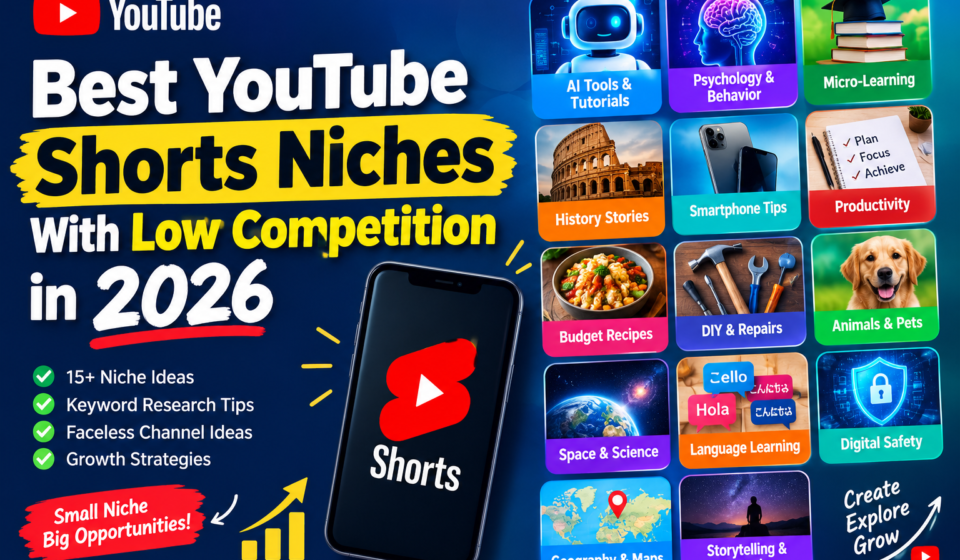

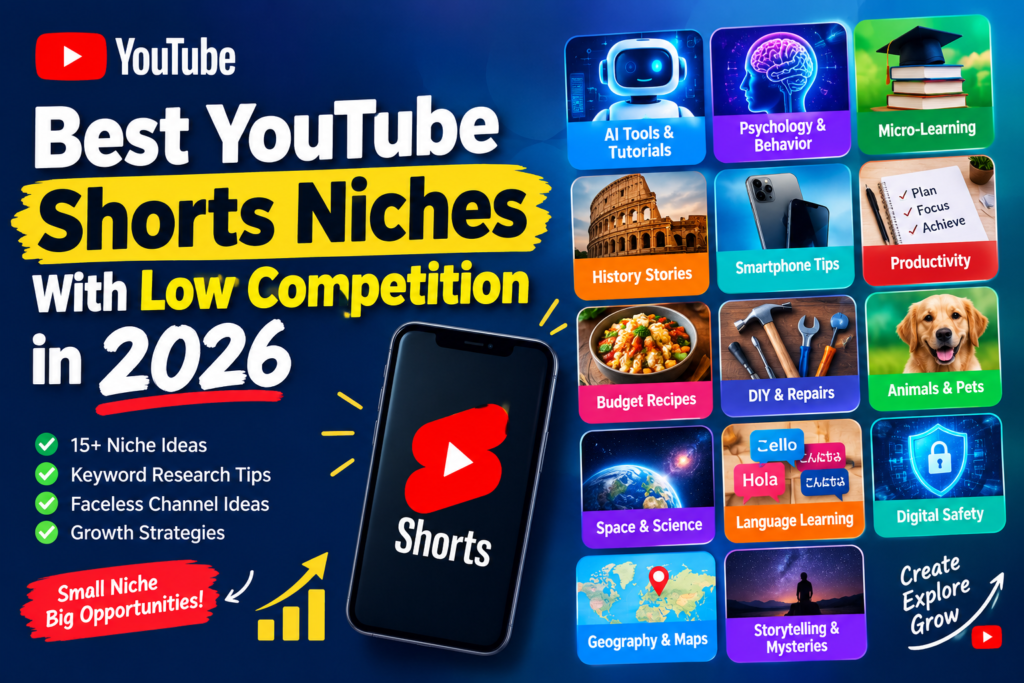
Best YouTube Shorts Niches With Low Competition in 2026
YouTube Shorts has created exciting opportunities for new content creators who want to grow an audience without investing in expensive equipment or producing lengthy videos. However, choosing the right niche is one of the most important decisions you will make when starting a channel.
With millions of creators publishing short-form videos, competing in broad categories such as gaming, entertainment, and general motivation can be challenging. The smarter approach is to find a specific topic that people enjoy watching but that you can cover with a distinctive perspective.
In this guide, you will discover the best YouTube Shorts niches with low competition in 2026, including faceless channel ideas, educational topics, AI content, storytelling, and practical tutorials. You will also learn how to validate a niche, find video ideas, and create Shorts that attract viewers and encourage them to subscribe.
Whether you are a complete beginner or an existing creator looking for a fresh direction, these niche ideas can help you build a focused YouTube content strategy.
What Makes a YouTube Shorts Niche Worth Targeting in 2026?
Before selecting a niche, understand that low competition does not automatically mean high demand. A topic may have very few competing creators because only a small audience is interested in it.
The best opportunities combine audience interest, room for original content, repeatable video ideas, and a production process you can maintain.
Here are four important factors to consider.
Audience demand: People should have a reason to watch your videos, whether they want entertainment, knowledge, inspiration, or a solution to a problem.
Content gaps: Look for questions that existing videos do not answer clearly or topics that established creators rarely cover in detail.
Repeatable ideas: Your niche should support dozens or hundreds of distinct Shorts rather than only a handful of videos.
Production feasibility: Choose a topic you can create consistently with your available time, knowledge, equipment, and budget.
Recent creator-industry research highlights AI tutorials, micro-learning, practical fitness tips, food content, and quick educational videos as promising short-form formats. However, individual results vary, and these categories are not automatically low competition. Your specific angle makes the difference.
15 Best YouTube Shorts Niches With Low Competition in 2026
The following niches are potential opportunities for new creators. Rather than treating an entire category as competition-free, focus on the narrower content ideas provided for each one.
1. AI Tools and Practical AI Tutorials
Artificial intelligence is changing how people work, study, create content, and manage everyday tasks. Many viewers want quick demonstrations showing how to use AI tools without watching lengthy tutorials.
Instead of creating generic videos about artificial intelligence, focus on solving one specific problem in each Short.
For example, you could demonstrate how to summarize a document, generate content ideas, organize research, or automate a repetitive task.
Why this niche is worth exploring:
- New tools and features create fresh content opportunities.
- Screen recordings make tutorials easy to understand.
- You can produce faceless videos using narration and demonstrations.
- Viewers may return for additional tips about the same tools.
YouTube Shorts ideas:
- 3 Free AI Tools Every Student Should Know
- This AI Tool Can Save You Hours of Work
- How to Turn Notes Into a Presentation With AI
- Best Free AI Tools for Small Business Owners
- 3 AI Prompts That Make Research Easier
Low-competition angle: Focus on AI tools for a particular audience, such as teachers, students, freelancers, or small business owners.
2. Fascinating Facts About Everyday Things
Fact-based Shorts can capture attention by revealing something surprising about objects, places, animals, or familiar experiences.
The challenge is that general fact channels are common. To differentiate your channel, specialize in a particular category and make sure your claims are accurate.
For example, you could explain the science behind everyday objects or reveal the history of ordinary inventions.
Why this niche is worth exploring:
- Topics can be explained in short videos.
- Interesting discoveries can encourage viewers to share.
- You can combine narration, illustrations, and original editing.
- A series format makes it easier to develop a recognizable channel.
YouTube Shorts ideas:
- Why Do Airplane Windows Have Small Holes?
- 3 Everyday Objects With Surprising Histories
- Why Does Metal Feel Colder Than Wood?
- The Hidden Purpose of Common Household Items
- One Strange Fact About the Human Brain
Low-competition angle: Choose a narrow subject, such as engineering facts, forgotten inventions, or the science behind everyday objects.
Always verify factual claims using reliable sources before publishing.
3. Psychology and Human Behavior Explained
People are naturally curious about decision-making, habits, communication, and the reasons behind everyday behavior.
This niche works well when each video explains one concept using a relatable example rather than making broad claims about personality.
For instance, you could explain why people procrastinate, how habits develop, or why first impressions influence social interactions.
Why this niche is worth exploring:
- Complex ideas can be broken into simple lessons.
- Everyday examples make concepts easier to understand.
- Series-based content encourages repeat viewing.
- Videos can be produced without appearing on camera.
YouTube Shorts ideas:
- Why Do We Procrastinate Even When We Have Time?
- The Psychology Behind First Impressions
- Why Your Brain Remembers Embarrassing Moments
- One Simple Way to Build Better Habits
- Why Small Rewards Can Help You Stay Consistent
Low-competition angle: Concentrate on evidence-based psychology for students, workplace behavior, or everyday habits.
Avoid presenting unsupported psychological claims as scientific facts or diagnosing viewers based on their behavior.
4. Micro-Learning and One-Minute Lessons
Micro-learning involves teaching one useful concept in a short, easy-to-understand video.
Instead of covering an entire subject, explain a single skill or answer one question per Short. This makes the content focused and gives viewers an immediate takeaway.
You could teach vocabulary, grammar, mathematics, computer skills, or useful facts about a specialized subject.
Why this niche is worth exploring:
- Educational videos can address specific questions.
- Topics can be organized into connected series.
- Viewers have a clear reason to subscribe for more lessons.
- Evergreen lessons can remain useful long after publication.
YouTube Shorts ideas:
- Learn 3 English Words in 30 Seconds
- One Excel Shortcut That Saves Time
- Understand Percentages With One Simple Example
- One Grammar Mistake English Learners Make
- Learn a Useful Computer Shortcut Today
Low-competition angle: Teach a specific skill to a clearly defined audience, such as English learners, beginner Excel users, or students preparing for a particular examination.
For example, a channel about Excel shortcuts for beginners is more focused than a general educational channel.
5. Historical Stories and Forgotten Events
History provides a large supply of stories about inventions, civilizations, discoveries, historical decisions, and overlooked individuals.
Short-form storytelling lets you introduce one event, explain why it mattered, and leave viewers with a memorable conclusion.
Rather than summarizing famous historical events that countless channels have covered, look for less familiar stories supported by credible sources.
Why this niche is worth exploring:
- Many historical topics remain relevant over time.
- Narration and illustrations can support faceless production.
- Individual stories can become recurring series.
- Unusual historical details can create curiosity.
YouTube Shorts ideas:
- The Invention That Changed Everyday Life
- A Forgotten City With a Fascinating History
- Why This Ancient Structure Was Built
- The Historical Mistake That Changed Everything
- An Invention That Was Ahead of Its Time
Low-competition angle: Focus on overlooked inventions, local history, historical mysteries with documented evidence, or the origins of everyday objects.
Use accurate dates and sources. If you use AI-generated historical illustrations, do not present them as authentic archival photographs.
6. Practical Smartphone Tips and Hidden Features
Millions of people use smartphones but do not know how to access every useful setting or feature.
This creates opportunities for short tutorials that solve specific problems, particularly when you focus on one device, operating system, or app.
Screen recordings can demonstrate each step without requiring a camera or expensive equipment.
Why this niche is worth exploring:
- Tutorials solve practical problems.
- Each video can demonstrate one feature.
- Search-focused topics may attract viewers looking for specific solutions.
- New software updates can provide additional video ideas.
YouTube Shorts ideas:
- 3 Android Settings You Should Check Today
- How to Free Up Storage Space on Your Phone
- Useful iPhone Features Beginners Often Miss
- How to Stop Unwanted App Notifications
- One Smartphone Setting That Can Improve Privacy
Low-competition angle: Create tutorials for a particular device model, operating system version, or audience unfamiliar with smartphone settings.
Verify every step on the relevant device before publishing, as features may differ between models and software versions.
7. Productivity Tips for Students and Professionals
Productivity content appeals to people who want to study more effectively, organize their schedules, manage tasks, and reduce distractions.
The broad productivity category is competitive, so the strongest approach is to teach specific techniques for particular situations.
For example, you could focus on exam preparation, time management for freelancers, or simple digital organization methods.
Why this niche is worth exploring:
- Problems are easy to identify and explain.
- Practical demonstrations make videos useful.
- You can create recurring series around daily challenges.
- Many topics remain relevant throughout the year.
YouTube Shorts ideas:
- A Simple Trick to Stop Procrastinating
- How to Plan Your Study Day in 30 Seconds
- 3 Free Tools for Better Time Management
- One Note-Taking Method Worth Trying
- How to Organize Your Tasks With a Simple System
Low-competition angle: Target a specific audience, such as university students, remote workers, freelancers, or people preparing for exams.
Avoid promising that a single technique will work for everyone. Demonstrate the method and explain when it may be useful.
8. Budget-Friendly Recipes and Cooking Hacks
Food content is highly visual, making it suitable for short-form videos. However, generic recipe videos face substantial competition.
A narrower focus, such as inexpensive meals, quick breakfasts, simple lunchbox recipes, or cooking for beginners, can help you build a recognizable channel.
Why this niche is worth exploring:
- The finished dish provides a natural visual payoff.
- Ingredients and preparation steps are easy to demonstrate.
- Viewers can save recipes for later.
- One set of ingredients can inspire several original recipes.
YouTube Shorts ideas:
- A Quick Breakfast You Can Make in 5 Minutes
- 3 Budget-Friendly Meals for Busy Students
- How to Make Crispy Potatoes at Home
- An Easy Lunchbox Recipe for Beginners
- One Simple Trick for Better Homemade Pasta
Low-competition angle: Specialize in affordable recipes, beginner cooking skills, meals using common ingredients, or regional dishes for an international audience.
Use your own cooking footage whenever possible. Original demonstrations help distinguish your videos from repetitive recipe compilations.
9. DIY Repairs and Everyday Problem-Solving
DIY Shorts can demonstrate how to solve small household problems, maintain everyday items, or organize limited space.
These videos work best when the viewer can immediately understand the problem and see the result.
You do not need to cover major construction projects. Simple, safe, and repeatable demonstrations can provide plenty of content.
Why this niche is worth exploring:
- Before-and-after visuals communicate value quickly.
- Many household problems generate specific search queries.
- Demonstrations can encourage viewers to save and share videos.
- You can organize content around particular rooms or everyday objects.
YouTube Shorts ideas:
- 3 Easy Ways to Organize a Small Desk
- How to Remove Sticker Residue From Glass
- A Simple Cable Organization Idea for Your Workspace
- How to Fix a Loose Cabinet Handle
- Small Storage Ideas for a Tiny Room
Low-competition angle: Focus on renter-friendly improvements, small-room organization, beginner DIY, or affordable workspace upgrades.
Clearly distinguish simple repairs from tasks involving electricity, gas, structural work, or other hazards that require qualified professionals.
10. Animal Behavior and Educational Pet Content
Animals attract attention because their behavior can be entertaining, surprising, and educational.
Instead of reposting viral pet clips, build a channel around original animal footage, responsible pet-care education, or explanations of animal behavior.
Why this niche is worth exploring:
- Animals offer strong visual storytelling opportunities.
- Educational clips can answer common pet-owner questions.
- The subject supports recurring video series.
- Original footage helps establish a distinctive identity.
YouTube Shorts ideas:
- Why Do Cats Knead Soft Blankets?
- What Your Dog’s Body Language May Mean
- 3 Common Mistakes New Cat Owners Make
- Why Do Birds Preen Their Feathers?
- Simple Ways to Make an Indoor Cat’s Environment More Interesting
Low-competition angle: Focus on one type of animal, beginner pet-owner education, or the behavior of common urban wildlife.
Use reputable animal-care sources and avoid interpreting a single behavior as a definitive sign of an animal’s emotional or medical condition.
11. Space and Science Explained Simply
Space and science provide endless opportunities to explain fascinating concepts in accessible language.
Instead of making broad videos about the universe, concentrate on a narrow subject such as planetary science, unusual scientific experiments, or the physics of everyday experiences.
Why this niche is worth exploring:
- Curiosity-driven questions can make strong hooks.
- Diagrams and animations can explain difficult concepts.
- Many scientific principles remain relevant for years.
- A series format helps viewers explore connected ideas.
YouTube Shorts ideas:
- What Would Happen if Earth Stopped Spinning?
- Why Is Space Almost Completely Silent?
- How Do Scientists Estimate the Age of Stars?
- Why Does the Moon Look Different Each Night?
- One Physics Fact That Explains Everyday Life
Low-competition angle: Explain scientific concepts through everyday examples or cover lesser-known discoveries in a specific field.
Make sure illustrations accurately represent the science. Clearly label hypothetical scenarios, and avoid presenting artistic visualizations as actual scientific photographs.
12. Language Learning and Pronunciation
Language-learning Shorts can help viewers practice vocabulary, pronunciation, grammar, and everyday conversation.
The opportunity becomes more specific when you create content for a particular language pair or learner level.
For example, you could teach English pronunciation to Urdu speakers or explain common English expressions for beginners.
Why this niche is worth exploring:
- Each video can teach one clear lesson.
- Viewers can practice immediately.
- Series-based lessons encourage repeat visits.
- Content can serve a clearly defined audience.
YouTube Shorts ideas:
- 5 English Words Beginners Often Mispronounce
- Everyday English Sentences for Beginners
- Stop Confusing These Two English Words
- Learn 3 Useful English Phrases in 30 Seconds
- Common English Mistakes Urdu Speakers Can Avoid
Low-competition angle: Focus on a particular learner group, such as Urdu-speaking beginners, business English learners, or students preparing for speaking examinations.
Include accurate pronunciation examples and natural sentences rather than relying only on word lists.
13. Digital Safety and Online Privacy Tips
People increasingly use online services for communication, shopping, work, and banking. Many want straightforward explanations of how to protect their accounts and personal information.
This niche can deliver useful educational Shorts without requiring advanced production equipment.
Why this niche is worth exploring:
- Practical problems provide clear video topics.
- Screen recordings can demonstrate settings.
- Educational content can remain useful for extended periods.
- New scams and software changes create opportunities for timely updates.
YouTube Shorts ideas:
- How to Recognize a Suspicious Email
- 3 Ways to Make Your Online Accounts Safer
- Why You Should Never Share Verification Codes
- How to Review App Permissions on Your Phone
- Common Signs of a Fake Website
Low-competition angle: Focus on digital safety for beginners, older smartphone users, freelancers, or small business owners.
Verify your advice against current guidance from trusted cybersecurity organizations. Avoid fearmongering and explain that no single security measure eliminates every risk.
14. Geography, Maps, and Country Comparisons
Geography Shorts can explore borders, unusual locations, population patterns, landmarks, and cultural differences.
Maps provide a useful visual foundation for short educational stories, and the niche supports many possible series.
Why this niche is worth exploring:
- Maps make abstract information easier to visualize.
- Each video can answer one geographic question.
- Country-specific topics support focused keyword targeting.
- Many subjects can be researched using public sources.
YouTube Shorts ideas:
- Why Do Some Countries Have Unusual Borders?
- 3 Countries With Fascinating Geographic Features
- Why Is This City Located in Such an Unusual Place?
- The World’s Most Interesting Island Borders
- How Geography Influences the Way Cities Develop
Low-competition angle: Focus on unusual borders, overlooked cities, regional geography, or the geography of a particular continent.
Use reliable maps and up-to-date statistics. Avoid misleading comparisons or oversimplifying complex political and historical issues.
15. Original Short Stories and Interactive Mysteries
Storytelling can be an effective format for creators who enjoy writing scripts, building suspense, and delivering satisfying endings.
You can create fictional mysteries, interactive puzzles, or short stories with unexpected but logical conclusions.
The key is to offer original narratives rather than repeatedly rewriting popular stories or copying material from other channels.
Why this niche is worth exploring:
- A strong opening can establish immediate curiosity.
- Stories naturally create a beginning, middle, and ending.
- Interactive questions can encourage meaningful comments.
- Recurring characters or formats can help build a recognizable channel.
YouTube Shorts ideas:
- Can You Solve This Mystery Before the Ending?
- The Strange Message That Appeared at Midnight
- Two Doors, One Clue: Which Would You Choose?
- A 30-Second Mystery With an Unexpected Ending
- Can You Find the Mistake in This Story?
Low-competition angle: Specialize in original logic mysteries, interactive detective puzzles, or short science-fiction stories.
Clearly label fictional stories and use original scripts, narration, visuals, and sound design.
Comparison of the Best YouTube Shorts Niches for Beginners
Choosing a niche becomes easier when you compare the type of content you want to create with the resources available to you.
The following ratings are practical planning estimates, not measured keyword-difficulty scores or guarantees of growth.
| YouTube Shorts Niche | Production Difficulty | Faceless Friendly | Content Potential |
|---|---|---|---|
| AI tools and tutorials | Easy to Medium | Yes | High |
| Everyday facts | Easy to Medium | Yes | High |
| Psychology and behavior | Medium | Yes | High |
| Micro-learning | Easy to Medium | Yes | High |
| Historical stories | Medium | Yes | High |
| Smartphone tips | Easy | Yes | High |
| Productivity | Easy to Medium | Yes | High |
| Budget recipes | Medium | Possible | High |
| DIY and repairs | Medium | Possible | High |
| Animal education | Medium | Yes, with original footage or visuals | High |
| Space and science | Medium to Hard | Yes | High |
| Language learning | Easy to Medium | Yes | High |
| Digital safety | Easy to Medium | Yes | High |
| Geography and maps | Medium | Yes | High |
| Original storytelling | Medium | Yes | High |
Important: Faceless-friendly does not mean effort-free. Research, writing, editing, and originality still matter. Production difficulty also depends on your experience and the tools you use.
Which YouTube Shorts Niche Is Best for Beginners?
There is no single niche that works best for everyone. Your ideal choice depends on your skills, interests, available resources, and target audience.
Here are five options worth considering based on different goals.
Best for Creators Interested in AI
Choose AI tools and practical tutorials if you enjoy experimenting with software and explaining how things work.
You can demonstrate actual workflows, compare features, and help a specific audience solve everyday problems.
Best for Faceless YouTube Channels
Choose historical stories, educational facts, or original storytelling if you prefer narration, illustrations, and screen-based editing.
These formats can work without showing your face, provided the videos contain original scripts, meaningful explanations, and appropriate visuals.
Best for Educational Content
Choose micro-learning or language learning if you can explain concepts clearly.
Teaching one useful idea per video creates a natural structure for building a series.
Best for Search-Focused Content
Choose smartphone tutorials, digital safety, or practical productivity tips if you want to answer specific questions people may search for.
Target precise problems rather than generic titles that compete with thousands of existing videos.
Best for Visual Content
Choose budget recipes, DIY projects, or animal education if you enjoy recording real-world demonstrations.
Original footage can help your channel stand apart from creators who rely on stock clips or repetitive templates.
How to Find Low-Competition YouTube Shorts Keywords
Selecting a niche is only the beginning. You also need video topics that have a realistic opportunity to reach your intended audience.
Follow this process before producing a large batch of Shorts.
Step 1: Start With a Specific Keyword
Avoid beginning with broad terms such as:
- AI
- Fitness
- History
- Cooking
- Psychology
These terms describe large categories rather than specific viewer needs.
Instead, explore narrower search phrases such as:
- Free AI tools for students
- Android storage cleanup tips
- Easy breakfast recipes for beginners
- English pronunciation practice
- Forgotten inventions in history
These phrases can help you identify more specific video ideas, although their actual search volume and competition must still be checked.
Step 2: Use YouTube Search Suggestions
Open YouTube and enter your main keyword into the search bar.
Pay attention to the suggestions that appear as you type. These can reveal related searches and questions that viewers may be interested in exploring.
For example, entering “Android tips” might suggest related searches about battery life, storage, privacy, or useful settings.
Record the relevant suggestions in a spreadsheet and turn them into possible video topics.
Remember that search suggestions are idea sources, not verified search-volume data.
Step 3: Study Existing Shorts
Search for your proposed topic and examine the results.
Look at the following factors:
- How recently competing videos were published.
- Whether smaller channels are receiving meaningful views.
- Whether existing videos answer the question clearly.
- Whether viewers are asking follow-up questions in the comments.
- Whether you can offer a more accurate, useful, or entertaining explanation.
A small channel receiving strong views can be an encouraging signal, but a single successful video does not prove that an entire niche is easy to enter.
Step 4: Use Keyword Research Tools
Keyword research tools can help you explore topic variations, related queries, and potential competition.
Consider researching with:
- urlGoogle Trendshttps://trends.google.com/trends/ — Explore interest over time and compare related search topics.
- urlvidIQhttps://vidiq.com/ — Research YouTube keywords and explore video optimization ideas.
- urlTubeBuddyhttps://www.tubebuddy.com/ — Explore YouTube keyword research and channel optimization tools.
- urlYouTube Studiohttps://studio.youtube.com/ — Review your own channel’s analytics and available audience research insights.
Some features may require an account or paid subscription.
Do not rely on a single tool’s keyword score. Compare several signals, including search interest, existing video performance, audience relevance, and your ability to create better content.
Step 5: Create a List of 30 Video Ideas
Before committing to a niche, try generating at least 30 distinct video ideas.
If you struggle to find enough topics, the niche may be too narrow or difficult for you to maintain.
Organize your ideas into categories such as:
- Beginner tutorials
- Common mistakes
- Frequently asked questions
- Comparisons
- Interesting facts
- Step-by-step demonstrations
- Myths versus facts
- Practical tips
This gives you a starting content calendar and makes it easier to maintain a consistent publishing schedule.
How to Create YouTube Shorts That Attract More Views
Even a promising niche will struggle if the videos fail to deliver what viewers expect. Your goal should be to make every Short clear, engaging, and worth watching.
1. Capture Attention Immediately
Start with the problem, question, or surprising fact rather than a lengthy introduction.
For example, instead of saying, “Welcome back to my channel, where we discuss useful smartphone tips,” try:
“Your phone may have a setting you’ve never checked.”
The opening should accurately represent the content that follows. Avoid misleading hooks that promise something the video never delivers.
2. Focus on One Main Idea
A Short should usually explain one main concept, demonstrate one useful feature, or tell one compact story.
Trying to cover too many unrelated points can make the video difficult to follow.
If you have five separate tips, consider turning them into a series of related Shorts rather than squeezing everything into one video.
3. Use Clear Visuals and Captions
Many Shorts are watched on small screens, so readable text and uncluttered visuals are important.
Use captions that are easy to follow, demonstrate relevant actions, and avoid filling every available space with text.
For tutorials, show the actual process. For educational stories, use visuals that directly support the explanation.
4. Edit for Pace and Clarity
Remove unnecessary pauses, repeated information, and unrelated footage.
However, faster editing is not automatically better. The pace should match the subject and allow viewers enough time to understand what is happening.
A simple, clear explanation can outperform a heavily edited video that leaves viewers confused.
5. Encourage Viewers to Return
Instead of asking viewers to subscribe after every sentence, give them a reason to want more content.
For example:
“Follow for one useful AI tool every day.”
This works best when you consistently publish the promised type of content.
You can also build recurring series, such as daily English lessons, smartphone tips, or one-minute history stories.
6. Review Your Analytics
After publishing several Shorts, review their performance in YouTube Studio.
Pay attention to available metrics such as:
- Viewed versus swiped away: Helps you understand whether viewers choose to watch or move past your Shorts.
- Audience retention: Helps identify where viewers stop watching.
- Average view duration: Shows how long viewers watch on average.
- Subscribers gained: Helps reveal which videos attract people who want more content.
Interpret these metrics in context rather than assuming a single number determines success.
Use the results to improve your hooks, pacing, topic selection, and explanations.
Can You Grow a Faceless YouTube Shorts Channel in 2026?
Yes. You can create a faceless Shorts channel using narration, screen recordings, original animations, demonstrations, diagrams, or other suitable visuals.
However, being faceless is a production choice, not a complete content strategy.
Successful faceless videos still need to provide something viewers value. That could be an original explanation, a useful demonstration, a well-researched story, or an entertaining concept.
Here are some practical approaches to faceless production:
Screen-recorded tutorials: Demonstrate software, smartphone settings, or AI tools while explaining each step.
Narrated educational videos: Use original scripts with relevant diagrams, illustrations, and licensed visual assets.
Animated storytelling: Create original characters, scenes, and narratives that support the story.
Hands-only demonstrations: Record cooking, crafts, repairs, or other practical activities without showing your face.
Map-based explainers: Use accurate maps and visual annotations to explain geography or historical events.
Be careful with mass-produced, repetitive content. YouTube’s monetization policies distinguish original, valuable content from repetitive or reused material that adds little meaningful value. AI assistance does not automatically make a video ineligible for monetization, but it does not excuse copying or low-effort production either.
Review the current policies in the official **