
YouTube Monetization 2026: How to Qualify Faster
Getting monetized on YouTube is an important milestone for creators who want to turn their passion into income. However, reaching the required subscriber count and watch hours can take time, especially if you are starting a new channel. The good news is that with the right content strategy, consistent uploads, and a clear understanding of YouTube’s monetization policies, you can work toward your goal more efficiently.
In this guide, you will learn how YouTube monetization works in 2026, what eligibility requirements you need to meet, how to gain subscribers and watch hours faster, and which mistakes you should avoid before applying to the YouTube Partner Program.
What Is YouTube Monetization?
YouTube monetization allows eligible creators to earn money from their content through advertising revenue, YouTube Premium, channel memberships, Super Thanks, and other available features.
To access these earning opportunities, creators generally need to join the YouTube Partner Program (YPP). YouTube reviews channels before approving them, so reaching the required numbers does not guarantee automatic acceptance.
Your channel must also comply with YouTube’s monetization policies, Community Guidelines, copyright rules, and other applicable requirements.
YouTube Monetization Requirements in 2026
Before creating a monetization strategy, you need to understand the difference between early access to certain earning features and full advertising revenue sharing.
1. Early Access to Monetization Features
In eligible countries and regions, creators may qualify for an expanded version of the YouTube Partner Program with the following requirements:
- At least 500 subscribers.
- At least three valid public uploads within the last 90 days.
- Either 3,000 valid public watch hours within the previous 12 months or 3 million valid public Shorts views within the previous 90 days.
This level can provide access to eligible features such as channel memberships, Super Thanks, Super Chat, and certain Shopping features. Availability depends on the feature and the creator’s location.
2. Full Monetization Through Ads
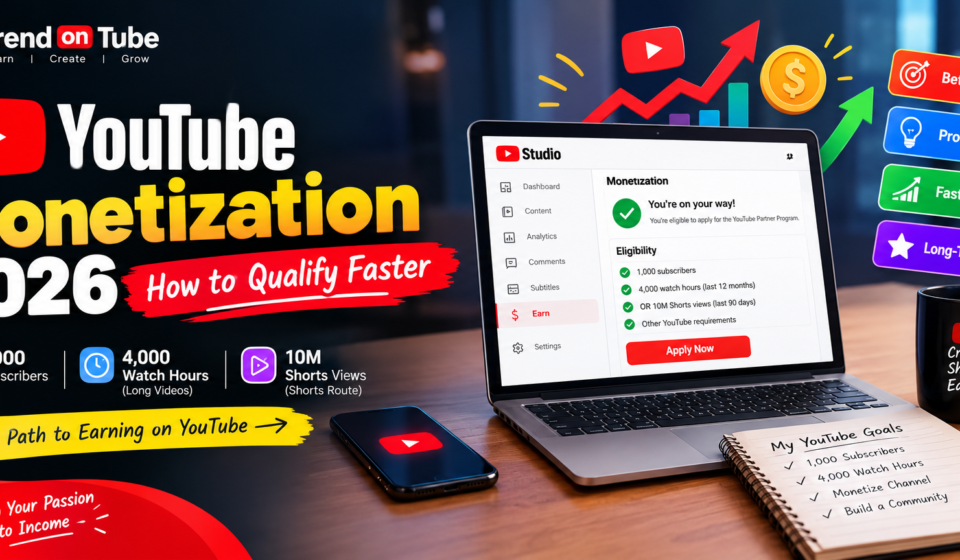
For advertising revenue sharing under the current 2026 requirements, creators generally need to meet one of these two routes:
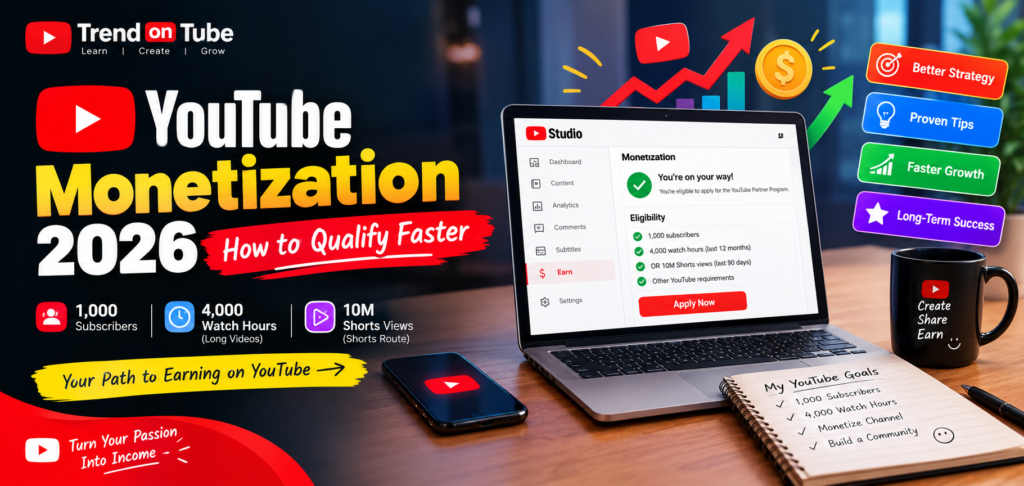
- Long-form video route: 1,000 subscribers and 4,000 valid public watch hours during the previous 12 months.
- YouTube Shorts route: 1,000 subscribers and 10 million valid public Shorts views during the previous 90 days.
These are alternative routes, not requirements that must both be completed. You must also satisfy the other YouTube Partner Program requirements.
Important 2027 update: YouTube has announced higher entry thresholds for new creators applying for ad and Premium revenue sharing from February 1, 2027: 8,000 qualified watch hours in the previous 365 days or 20 million qualified Shorts views in the previous 90 days. The subscriber requirement and other eligibility conditions should also be checked in YouTube Studio before applying.
Always review the latest requirements in the official YouTube Help Center because eligibility rules can change.
How to Qualify for YouTube Monetization Faster
There is no guaranteed shortcut to monetization, but focusing on the right activities can help you build an audience more efficiently.
1. Choose a Profitable and Focused YouTube Niche
One of the first steps toward monetization is choosing a clear topic for your channel. A focused niche helps viewers understand what your content offers and gives them a reason to subscribe.
Consider topics such as:
- Technology tutorials and software guides
- Educational content and practical skills
- AI tools and productivity tutorials
- Personal finance education
- Gaming guides and walkthroughs
- Cooking and recipe demonstrations
- YouTube growth and content creation tips
Do not select a niche simply because someone claims it pays well. Choose a subject that matches your knowledge, interests, and ability to create useful videos consistently.
Before committing, research existing channels, viewer questions, search results, and the types of videos attracting engagement. Look for specific topics that established creators have not explained clearly.
2. Research YouTube Keywords Before Making Videos
YouTube keyword research helps you understand what your potential audience is searching for.
Instead of targeting broad keywords such as “technology” or “make money online,” consider more specific phrases such as:
- How to use AI tools for video editing
- How to fix common YouTube Studio problems
- Best free video editing apps for beginners
- How to improve YouTube Shorts retention
- How to create thumbnails without Photoshop
Long-tail keywords can help you target a more specific audience. However, they are not automatically low-competition keywords, so examine the actual search results before choosing a topic.
Include your primary keyword naturally in your video title, description, and spoken content where appropriate. Avoid repeating keywords excessively or adding unrelated terms to attract clicks.
3. Create Videos That Solve Specific Problems
People often watch videos because they want an answer, a solution, or entertainment. Your videos should deliver on the promise made by their titles and thumbnails.
For example, a video titled “How to Get Your First 100 YouTube Subscribers” should provide practical steps, examples, and realistic expectations rather than vague motivational advice.
Before recording, outline the main points you want to cover. Start with the viewer’s problem, explain what they will learn, and move directly into useful information.
Avoid lengthy introductions that delay the main topic. The faster viewers understand the value of your video, the more likely they are to continue watching.
4. Use YouTube Shorts to Discover New Viewers
YouTube Shorts can help new creators introduce their channels to a wider audience.
Create short videos that communicate one useful idea, answer one question, demonstrate one technique, or deliver one entertaining moment.
For example, if your channel focuses on YouTube growth, you could publish Shorts about common SEO mistakes, thumbnail improvements, editing tips, or useful creator tools.
To improve your Shorts strategy:
- Capture attention within the opening seconds.
- Keep the video focused on one central idea.
- Use clear narration, readable captions, and relevant visuals.
- Remove unnecessary pauses.
- Encourage viewers to explore related videos on your channel.
- Study audience retention and engaged views in YouTube Analytics.
Remember that Shorts watch time from the Shorts Feed does not count toward the 4,000-hour long-form requirement. Shorts views and long-form watch hours are measured through different eligibility routes.
5. Publish Long-Form Videos to Build Watch Hours
If you choose the long-form monetization route, your goal is to accumulate 4,000 valid public watch hours within a rolling 12-month period under the current 2026 requirements.
Long-form tutorials, detailed explanations, reviews, case studies, and educational videos can help you build watch time when viewers find them useful.
Consider creating videos that answer related questions in depth. For example, a channel about YouTube SEO could publish separate videos on keyword research, video descriptions, thumbnails, audience retention, and analytics.
A useful series can encourage viewers to watch more than one video during a visit to your channel.
You should prioritize viewer satisfaction rather than making videos unnecessarily long. A clear eight-minute tutorial may be more effective than a poorly structured twenty-minute video.
Understanding the numbers: If your videos collectively receive 60,000 valid views with an average viewing duration of four minutes, that represents approximately 4,000 watch hours.
This is a mathematical illustration, not a prediction of how many views your channel will need. Actual results depend on average viewing duration and which views qualify toward the threshold.
6. Improve Your Titles and Thumbnails
Your video title and thumbnail help viewers decide whether to click.
A strong title identifies the topic and communicates a clear benefit. A good thumbnail supports the title with an understandable visual rather than repeating every word.
For example:
Weak title: My New YouTube Video
Improved title: How to Reach 1,000 YouTube Subscribers as a Beginner
For thumbnails, use clear imagery, readable text where needed, strong visual contrast, and a simple composition. Check how the design appears on a mobile screen before publishing.
Avoid misleading claims. If the video promises a specific result, it should deliver useful information relevant to that promise.
After publishing, review impressions, click-through rate, and audience retention together. A high click-through rate does not necessarily mean a video is satisfying viewers, while a lower rate may reflect the audience or context in which the video is shown.
7. Build a Consistent Upload Schedule
Consistency helps you develop a repeatable production process and gives your audience opportunities to discover new content.
You do not need to upload multiple videos every day. Choose a schedule you can maintain without sacrificing quality.
A manageable beginner schedule might include:
- Two useful long-form videos per week.
- Three to five Shorts per week, if they fit your content strategy.
- One weekly review of YouTube Analytics.
Treat this as a starting point rather than a fixed rule. Your ideal publishing frequency depends on your niche, production time, and the response from your audience.
Batching research, scripting, recording, and editing can also make your workflow more efficient.
8. Organize Your Channel With Playlists
Playlists help viewers find related content and can make it easier to explore your channel.
Group videos into meaningful categories, such as beginner tutorials, advanced guides, tool reviews, or troubleshooting lessons.
At the end of each video, direct viewers to a genuinely relevant next video. You can also use end screens, cards where appropriate, and pinned comments to guide viewers toward related content.
Do not assume that playlists automatically generate watch hours. Their value comes from helping interested viewers discover more of your useful content.
9. Use YouTube Analytics to Improve Performance
YouTube Analytics provides information about how people discover and watch your videos.
Pay attention to these metrics:
- Impressions: How often eligible thumbnails are shown.
- Click-through rate: The percentage of impressions that result in views.
- Average view duration: How long viewers watch on average.
- Audience retention: Which parts of a video hold or lose viewers.
- Returning viewers: Whether people come back to your channel.
- Subscribers gained: Which videos attract new subscribers.
- Watch time and engaged views: How your videos contribute to audience growth and relevant Shorts performance.
Look for patterns rather than judging a video by one metric. If viewers leave early, examine whether the introduction is too long or the content fails to meet their expectations.
If a particular topic consistently attracts relevant viewers, create more content that answers related questions.
10. Promote Your Videos to Relevant Audiences
Sharing videos outside YouTube can help you reach people who are already interested in your subject.
You might share a tutorial in a relevant online community, embed a video in a related blog post, or publish a short preview on another social platform.
Always follow the rules of the community where you share content. Avoid spam, artificial engagement schemes, and services that promise guaranteed subscribers or views.
Paid advertising is not a shortcut to monetization eligibility. Watch time from ad campaigns does not count toward the applicable public watch-hour threshold, and advertising views do not qualify as Shorts views for the threshold. Organic viewing behavior after promotion may be treated differently under YouTube’s rules.
Do Subscribers or Watch Hours Matter More?
Both matter for the long-form advertising route because you need to satisfy the subscriber requirement and the watch-hour requirement.
If your channel has 1,500 subscribers but only 1,000 valid public watch hours, you have not yet reached the current 4,000-hour threshold.
Similarly, a channel with 4,000 valid public watch hours but only 700 subscribers has not satisfied the 1,000-subscriber requirement for full ad revenue sharing.
For the Shorts route, you must satisfy the subscriber requirement alongside the required number of qualified Shorts views within the specified period.
The best approach is to monitor both sides of your chosen route and create content designed to attract the right audience.
Common YouTube Monetization Mistakes to Avoid
Some channels reach the numerical requirements but fail the monetization review because their content does not meet YouTube’s policies.
Reusing Other People’s Videos
Uploading other creators’ videos, movie clips, television footage, or compilations without sufficient original contribution can create monetization problems.
Adding minor edits, captions, background music, or a different intro does not automatically make reused content eligible.
If you use third-party material, understand its copyright status and add meaningful original commentary, analysis, education, or creative contribution where appropriate. Even permission from a copyright owner does not guarantee that content will pass YouTube’s separate reused-content monetization review.
Publishing Mass-Produced or Repetitive Content
YouTube expects monetized content to be original and authentic. Channels built around repetitive, mass-produced, or minimally differentiated videos may be rejected under its inauthentic-content policies.
AI tools can assist with research, scripting, editing, and production, but using AI does not remove the need for originality and viewer value.
Develop your own explanations, examples, structure, analysis, and creative direction rather than publishing large numbers of nearly identical videos.
Buying Subscribers or Views
Purchased subscribers, automated views, engagement exchanges, and other artificial growth tactics can damage your channel and violate YouTube’s policies.
These tactics also fail to build a dependable audience. A large subscriber count is not useful if viewers are not genuinely interested in your content.
Focus on attracting people who are likely to watch, engage, and return.
Ignoring Copyright and Community Guidelines
Use music, footage, images, and other assets only when you have the necessary rights or a valid legal basis to use them.
Also review YouTube’s Community Guidelines and advertiser-friendly content requirements. Repeated policy problems can threaten your ability to monetize even if you have sufficient subscribers and watch hours.
Forgetting the Other Eligibility Requirements
Before applying, make sure you meet the applicable requirements, including:
- Living in a country or region where the YouTube Partner Program is available.
- Having no active Community Guidelines strikes.
- Enabling two-step verification for your Google Account.
- Having access to YouTube advanced features.
- Linking an active AdSense for YouTube account when required.
- Accepting the relevant program terms and monetization modules.
YouTube reviews the channel as a whole, so meeting the numerical targets is only one part of the process.
How to Apply for YouTube Monetization
Once your channel meets the requirements, follow these steps:
Step 1: Sign in to your YouTube account and open YouTube Studio.
Step 2: Select the Earn section from the left-hand menu.
Step 3: Review your eligibility status and make sure the required milestones have been met.
Step 4: Select Apply Now when the option becomes available.
Step 5: Review and accept the applicable YouTube Partner Program terms.
Step 6: Set up or link your AdSense for YouTube account through YouTube Studio.
Step 7: Submit your application for review and monitor its status in the Earn section.
YouTube uses automated systems and human reviewers to assess whether your channel follows its policies. Review times vary, so approval is not guaranteed by a particular date.
Before applying, review your most-viewed videos, newest uploads, channel description, titles, thumbnails, and overall content quality. Resolve any policy issues you can identify.
What Happens After Your Channel Gets Monetized?
Approval opens the door to eligible monetization features, but it does not guarantee a particular income.
Your earnings depend on factors such as viewer location, subject matter, advertiser demand, video format, audience behavior, and the monetization features you use.
Long-form videos may earn advertising revenue through watch-page ads, while eligible Shorts can earn through the Shorts Feed revenue-sharing system. Other available options can include YouTube Premium revenue, memberships, Super Thanks, and Shopping.
To build a more sustainable creator business, focus on serving a clear audience and producing content that remains useful over time. As your channel grows, you can also explore relevant sponsorships, affiliate partnerships, or your own products, subject to applicable rules and disclosure requirements.
A Practical 30-Day Plan to Work Toward Monetization
If you are starting from zero, use the following plan to establish a consistent publishing routine.
Week 1: Research and planning
- Choose one clear niche and define your target audience.
- Research 15–20 relevant video topics.
- Identify specific search queries and questions viewers ask.
- Plan your first four long-form videos and several related Shorts.
Week 2: Publish and test
- Publish two useful long-form videos.
- Create Shorts that highlight individual tips from your content.
- Improve your titles and thumbnails.
- Check early audience retention and viewer feedback.
Week 3: Improve your content
- Review which topics attract the most relevant viewers.
- Improve introductions and remove unnecessary sections.
- Publish more videos related to promising topics.
- Link related videos through playlists and end screens.
Week 4: Review and refine
- Check your subscriber growth and eligible watch time or Shorts views.
- Identify your strongest videos and the reasons they performed well.
- Plan the next month’s content based on audience response.
- Review your monetization progress in YouTube Studio.
This plan is designed to help you establish a repeatable workflow, not guarantee monetization within 30 days. Reaching the eligibility thresholds can take considerably longer.
Frequently Asked Questions About YouTube Monetization 2026
How many subscribers do you need to monetize YouTube in 2026?
For full advertising revenue sharing under the current 2026 requirements, you generally need at least 1,000 subscribers and either 4,000 valid public watch hours within 12 months or 10 million qualified public Shorts views within 90 days. Some eligible creators can access selected monetization features earlier through the expanded YPP.
Can I monetize YouTube Shorts in 2026?
Yes. Eligible creators can earn revenue from Shorts through the YouTube Partner Program. For full ad revenue sharing, the current Shorts route generally requires 1,000 subscribers and 10 million qualified public Shorts views within 90 days, alongside other eligibility requirements.
Do Shorts watch hours count toward 4,000 watch hours?
No. Watch time from views in the Shorts Feed does not count toward the 4,000 valid public watch-hour requirement. That threshold is based on qualifying public long-form videos and eligible archived livestreams.
Can a new YouTube channel get monetized quickly?
Yes, a new channel can qualify once it meets the applicable requirements and passes review, but there is no guaranteed timeline. A focused niche, useful content, effective packaging, and consistent improvement can help you make progress.
Does YouTube pay for every view?
No. Not every view generates advertising revenue. Earnings depend on factors such as ad availability, viewer location, monetization eligibility, format, and other revenue sources. Some views may generate no ad revenue at all.
Can AI-generated videos be monetized?
AI-assisted videos can be monetized when they comply with YouTube’s policies and provide original, authentic value. Mass-produced, repetitive, or minimally differentiated content may be ineligible. Creators must also follow applicable disclosure rules for altered or synthetic content.
How long does YouTube monetization approval take?
Review times vary. YouTube’s guidance indicates that reviews typically take about a month, but delays can occur. Check the status of your application in YouTube Studio.
Final Thoughts
Qualifying for YouTube monetization in 2026 requires more than reaching a subscriber milestone. You need to build a real audience, generate eligible watch time or Shorts views, and create content that complies with YouTube’s policies.
Start with a clear niche, research topics your audience cares about, publish useful videos consistently, and use analytics to understand what works. Avoid artificial engagement, low-value repetitive content, and copyright risks.
Most importantly, check the Earn section of YouTube Studio regularly and verify the latest eligibility rules before applying. With a sustainable strategy and a commitment to original content, you can work toward monetization while building a channel that has long-term potential.