
YouTube Algorithm 2026: How to Get Recommended More
Getting your YouTube videos recommended is one of the best ways to reach new viewers, grow your subscribers, and build a successful channel. But with millions of videos being uploaded, simply publishing content is no longer enough. You need to understand how the YouTube algorithm works in 2026 and create videos that viewers actually want to watch.
The YouTube recommendation system is designed to help viewers discover videos they are likely to enjoy. It considers numerous signals related to viewer behavior, satisfaction, relevance, and content performance. This means there is no single trick that can guarantee viral views.
The good news is that creators can improve their chances of getting recommended by focusing on the right topics, creating compelling titles and thumbnails, keeping viewers engaged, and consistently delivering valuable content.
In this guide, you’ll learn how the YouTube algorithm works in 2026 and the practical strategies you can use to get your videos recommended to more viewers.
What Is the YouTube Algorithm?
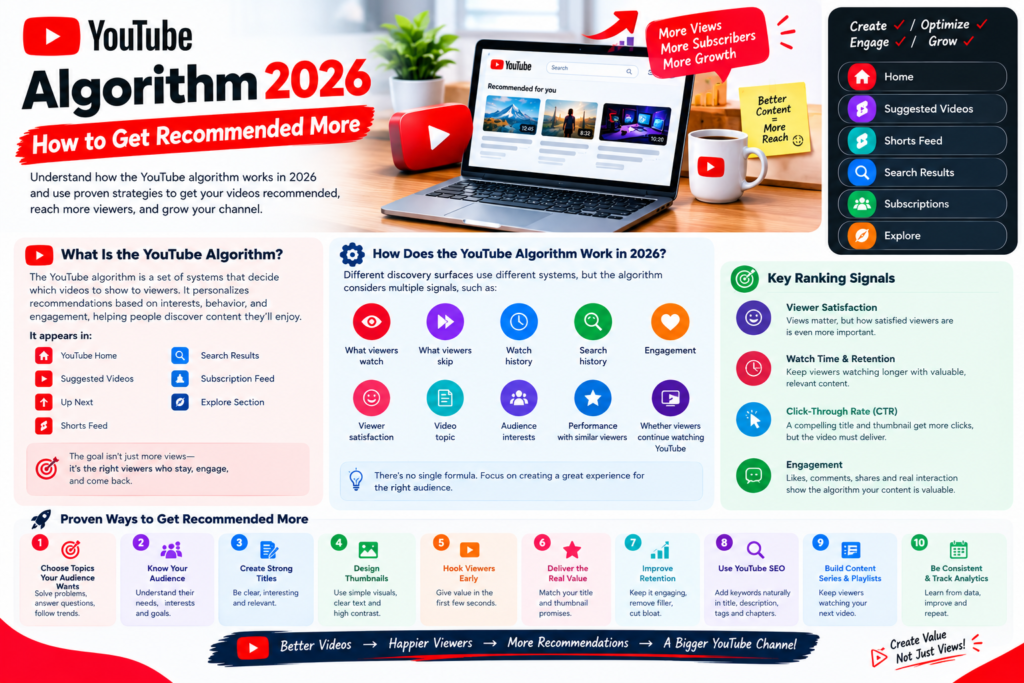
The YouTube algorithm is a collection of systems that help determine which videos are shown to viewers across YouTube.
Rather than showing exactly the same videos to everyone, YouTube personalizes recommendations based on each viewer’s interests and behavior.
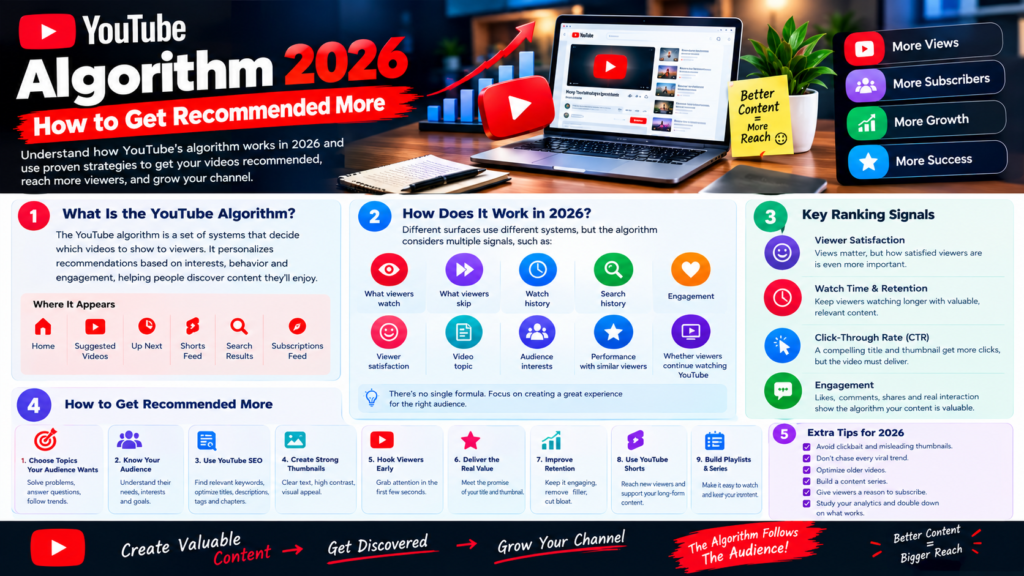
Recommendations can appear in places such as:
- YouTube Home
- Suggested Videos
- Up Next
- Shorts feed
- Search results
- Subscription feeds
- Explore sections
The algorithm tries to match viewers with videos they are likely to watch and enjoy.
This is important because the goal isn’t simply to make YouTube “like” your video. Your goal should be to make a video that satisfies the right audience.
How Does the YouTube Algorithm Work in 2026?
Many beginners think YouTube has one universal algorithm that decides whether a video becomes viral. In reality, different discovery surfaces use different systems and signals.
For example, YouTube Search is heavily concerned with relevance and how well a video matches a searcher’s query, while recommendations are more personalized around the viewer.
The algorithm can consider signals such as:
- What viewers watch
- What viewers skip
- Watch history
- Search history
- Engagement
- Viewer satisfaction
- Video topic
- Audience interests
- Performance with similar viewers
- Whether viewers continue watching YouTube after seeing the content
This means there is no guaranteed formula such as “get exactly X% retention and YouTube will promote your video.”
Instead, focus on creating a strong overall viewer experience.
The Most Important YouTube Ranking Signals
Understanding the major factors that influence discovery can help you make better content decisions.
Viewer Satisfaction
Views alone don’t tell the complete story.
A viewer may click a video but leave after a few seconds because the content doesn’t meet their expectations. Another video may receive fewer initial clicks but create highly satisfied viewers who continue watching related content.
Your objective should be to deliver what your title and thumbnail promise.
Watch Time and Retention
Audience retention shows how long viewers continue watching your video.
If viewers consistently leave at the beginning, your introduction may need improvement.
If viewers stay until the end, your content may be doing a good job of maintaining interest.
However, don’t try to artificially extend videos just to increase watch time. A useful five-minute video can be better than a repetitive twenty-minute video.
Click-Through Rate
Click-through rate, commonly called CTR, measures how frequently viewers click after seeing your video impression.
A compelling title and thumbnail can increase the likelihood that someone chooses your video.
But a high CTR is not enough by itself.
If a thumbnail generates clicks but the video disappoints viewers, the result may be poor overall performance.
Think of your title and thumbnail as a promise.
Your video should fulfill that promise.
Engagement
Likes, comments, shares, and other interactions can provide useful feedback about how viewers respond to content.
Encourage genuine discussion by asking relevant questions.
For example:
“Which YouTube growth strategy are you going to try first?”
This can create a natural reason for viewers to participate.
Don’t use engagement bait that has nothing to do with the video.
How to Get Your Videos Recommended More
Getting recommended is not about discovering a secret algorithm hack. It is about creating content that matches viewer demand and consistently satisfies your target audience.
Here are the most effective strategies to focus on in 2026.
1. Choose Topics Your Audience Already Wants
Before making a video, ask yourself whether your target audience actually cares about the topic.
Instead of creating videos based entirely on what you want to discuss, research questions, problems, trends, and interests within your niche.
For example, if your channel focuses on YouTube growth, potential topics include:
- How to Get More YouTube Views
- YouTube SEO for Beginners
- How to Get Your First 100 Subscribers
- YouTube Shorts Growth Strategies
- How to Find Low-Competition Keywords
- YouTube Thumbnail Tips
- How to Improve Audience Retention
The strongest topics solve a problem or satisfy a clear desire.
2. Understand Your Target Audience
The YouTube algorithm doesn’t operate independently of viewers.
If you understand your audience, you can create content that is more likely to generate meaningful viewing sessions.
Identify:
- Who your viewers are
- What problems they have
- What they want to achieve
- What questions they ask
- What videos they already watch
- What topics keep them interested
For example, a beginner interested in YouTube growth has very different needs from an experienced creator with 500,000 subscribers.
Create content for a specific audience rather than trying to appeal to everyone.
3. Create Strong YouTube Titles
Your title is one of the first things a viewer sees.
A strong title should communicate the topic and create enough curiosity to encourage a click without misleading the viewer.
Instead of:
“Some YouTube Tips”
Try:
“7 YouTube Algorithm Mistakes Killing Your Views in 2026”
Instead of:
“My New YouTube Strategy”
Try:
“How to Get Your Videos Recommended More in 2026”
Useful title formulas include:
- How to [Get a Specific Result]
- X Ways to [Solve a Problem]
- X Mistakes That Are Killing Your [Result]
- The Complete Guide to [Topic]
- How to [Result] Without [Common Problem]
- [Topic] Explained for Beginners
Use keywords naturally rather than stuffing the same phrase repeatedly.
4. Create Thumbnails That Stand Out
Your thumbnail and title work together.
The thumbnail should quickly communicate the video’s main idea and make the viewer curious enough to learn more.
Effective thumbnail principles include:
- Use one clear visual idea
- Keep text short
- Make important elements easy to recognize
- Use strong visual contrast
- Avoid unnecessary clutter
- Design for mobile screens
- Make the thumbnail relevant to the video
For example, if your video is about growing from zero subscribers, a simple concept such as:
0 → 1,000 SUBSCRIBERS
can communicate the benefit immediately.
Don’t make thumbnails misleading simply to generate clicks.
5. Hook Viewers in the First Few Seconds
The opening of your video matters.
Many creators spend too much time with introductions such as:
“Hey everyone, welcome back to my channel…”
Instead, give viewers a reason to continue.
For example:
“Your YouTube videos may not be getting recommended because you’re focusing on the wrong signals. In this video, I’ll show you seven changes you can make to improve your chances of reaching new viewers.”
This immediately establishes the problem and the promised value.
Your introduction should answer one question:
Why should I keep watching?
6. Deliver the Value Promised by Your Title
One of the most important YouTube growth principles is expectation matching.
Suppose your title says:
“How to Get 1,000 YouTube Subscribers”
The viewer expects practical information about reaching that milestone.
If the video spends most of its time discussing unrelated personal stories, viewers may lose interest.
Your title, thumbnail, introduction, and actual content should tell the same story.
This creates a better viewer experience.
7. Improve Audience Retention
Audience retention can show where viewers lose interest.
If you notice a major drop at a particular point, investigate what happens there.
Perhaps:
- The explanation becomes too long
- The video repeats information
- The editing becomes slow
- The topic changes unexpectedly
- You introduce unnecessary details
- The viewer already received the answer
Use retention data as feedback rather than chasing an arbitrary percentage.
Your goal is to keep providing value throughout the video.
8. Use YouTube SEO Strategically
SEO remains useful for helping YouTube understand what your content is about and connecting it with relevant searches.
Start with keyword research.
Look for specific phrases your audience might search for.
For example:
Broad keyword:
YouTube SEO
Long-tail keyword:
YouTube SEO for beginners in 2026
More specific keyword:
How to rank YouTube videos for beginners
Long-tail keywords can be especially useful for smaller channels because they allow you to target more specific search intent.
Include the primary keyword naturally in:
- Video title
- Description
- Spoken content
- Relevant tags where appropriate
- Chapters when relevant
Don’t repeat keywords unnaturally.
9. Make Content That Encourages Viewers to Watch More
A successful YouTube channel isn’t built from individual videos alone.
You want viewers to discover one useful video and then find another relevant video.
For example:
Video 1: How to Find YouTube Keywords
Video 2: How to Write YouTube Titles
Video 3: How to Create Better Thumbnails
Video 4: How to Improve Audience Retention
Video 5: How to Get More YouTube Views
These videos naturally connect with one another.
You can use playlists, end screens, cards where appropriate, and verbal recommendations to guide interested viewers toward related content.
10. Use YouTube Shorts Strategically
Shorts can help creators expose their content to new audiences.
Instead of creating completely unrelated Shorts, connect them to your main channel topic.
For example, a YouTube SEO channel could create Shorts about:
- One keyword research mistake
- One thumbnail tip
- One title-writing technique
- One YouTube Analytics tip
- One audience retention trick
You can then create longer videos that provide deeper explanations.
The important thing is audience relevance.
A Short that attracts millions of viewers who have no interest in your long-form content may not produce the type of audience you actually want.
11. Publish Consistently
Consistency helps you build a content library and gives you more opportunities to learn.
However, consistency doesn’t mean you must upload every day.
A realistic schedule might be:
- One long-form video per week
- Several Shorts throughout the week
- Regular community interaction
Another creator may prefer two long-form videos per week.
Choose a schedule you can maintain without sacrificing quality.
Consistency should be sustainable.
12. Study Your YouTube Analytics
Analytics can reveal what your audience responds to.
Important metrics to monitor include:
- Impressions
- Click-through rate
- Views
- Watch time
- Audience retention
- Traffic sources
- Subscribers gained
- Returning viewers
- Top-performing videos
Don’t look at metrics individually.
For example, a high CTR might initially look positive, but if viewers leave quickly, you need to investigate whether the title and thumbnail are creating expectations that the video doesn’t meet.
Look for patterns.
13. Double Down on Winning Topics
If a video performs significantly better than your average content, don’t immediately move to an unrelated subject.
Ask why it worked.
Was it:
- The topic?
- The timing?
- The title?
- The thumbnail?
- The format?
- The audience problem?
- The presentation?
Then create related content.
For example, if:
“How to Get Your First 100 YouTube Subscribers”
performs exceptionally well, related topics could include:
- How to Get Your First 500 Subscribers
- Why New YouTube Channels Get No Views
- How to Get Your First 1,000 Subscribers
- YouTube SEO Tips for Small Channels
One successful topic can become an entire content cluster.
14. Don’t Chase Every Viral Trend
Trends can produce temporary traffic, but they aren’t always good for your channel.
Before covering a trend, ask:
Does this topic fit my audience?
If your channel teaches YouTube SEO and a completely unrelated entertainment trend suddenly becomes viral, covering it may attract viewers who never watch your other videos.
Choose trends that align with your niche.
15. Build a Strong Content Series
Series can encourage viewers to return.
For example:
YouTube Growth From Zero
Part 1: Choose a YouTube Niche
Part 2: Find Low-Competition Keywords
Part 3: Create Your First Video
Part 4: Make Better Thumbnails
Part 5: Get Your First 100 Subscribers
Part 6: Analyze YouTube Analytics
A series also makes content planning easier because each video naturally leads to another.
16. Give Viewers a Reason to Subscribe
A viewer doesn’t necessarily subscribe simply because a video was good.
They subscribe when they believe your future content will also be valuable.
Instead of repeatedly saying:
“Subscribe to my channel.”
Explain why they should.
For example:
“If you’re building a YouTube channel from zero, subscribe for weekly tutorials on YouTube SEO, Shorts, thumbnails, and channel growth.”
This gives viewers a clear expectation.
17. Avoid Clickbait That Disappoints Viewers
Clickbait is often misunderstood.
A compelling title isn’t automatically bad.
The problem occurs when the title or thumbnail creates an expectation that the video doesn’t satisfy.
For example:
Title:
“How I Got 100,000 Subscribers in 30 Days”
If the video never explains the process and simply discusses general YouTube advice, viewers may become disappointed.
Instead, create curiosity while remaining truthful.
Good packaging attracts the right viewer.
18. Don’t Obsess Over a Single Metric
There is no single magic number that guarantees recommendations.
You shouldn’t assume:
“CTR is everything.”
Or:
“Watch time is everything.”
Or:
“Likes are everything.”
YouTube’s systems consider multiple signals and personalize recommendations for individual viewers.
A better approach is to evaluate the complete viewer journey:
Impression → Click → Watch → Satisfaction → Further Viewing
Improving every stage can make your channel stronger.
19. Optimize Your Old Videos
You don’t always need to create a brand-new video to improve your channel.
Review older content.
If a useful video has a weak title or thumbnail, consider whether its packaging can be improved.
You can also:
- Improve the description
- Add relevant chapters
- Update links
- Improve playlists
- Add relevant end-screen destinations
- Create a newer video covering the same topic in greater depth
Don’t change successful videos unnecessarily. Focus on content where there is a clear opportunity for improvement.
20. Create for Humans Before Algorithms
This is perhaps the most important YouTube strategy for 2026.
Don’t make videos solely because you think an algorithm will like them.
Make videos because a real person needs them.
Instead of thinking:
“How do I trick YouTube into recommending this?”
Think:
“How do I make the right viewer click, enjoy, and feel satisfied with this video?”
That mindset naturally improves your topic selection, titles, thumbnails, scripts, editing, and overall content quality.
Common YouTube Algorithm Mistakes to Avoid
Keyword Stuffing
Repeating the same keyword unnecessarily can make your content look unnatural.
Misleading Thumbnails
A thumbnail should attract attention without making false promises.
Long Introductions
Get to the value quickly.
Random Content
Unrelated videos can make it harder to build a consistent audience.
Copying Competitors
Study successful creators, but develop your own perspective.
Buying Subscribers or Views
Artificial activity doesn’t create a genuine audience and can damage your channel strategy.
Uploading Without Reviewing Analytics
Publishing more videos isn’t enough if you never learn from the results.
Giving Up Too Quickly
Some channels require many uploads before creators identify what their audience truly wants.
A Simple YouTube Algorithm Strategy for Beginners
If you’re starting a new channel, follow this basic process:
Step 1: Choose a specific niche.
Step 2: Identify your target audience.
Step 3: Research problems and questions.
Step 4: Find relevant keywords.
Step 5: Create a strong video concept.
Step 6: Write an attention-grabbing but accurate title.
Step 7: Design a clear thumbnail.
Step 8: Hook viewers quickly.
Step 9: Deliver valuable information.
Step 10: Encourage viewers to watch relevant content.
Step 11: Review your analytics.
Step 12: Improve your next video.
Repeat the process consistently.
YouTube Algorithm 2026: The Bottom Line
The YouTube algorithm in 2026 isn’t something creators need to fear. It is designed to help viewers find content they are likely to watch and enjoy.
You cannot force YouTube to recommend a video, but you can improve the factors that make your content more appealing to the right audience.
Focus on creating valuable topics, understanding your viewers, improving titles and thumbnails, delivering strong introductions, maintaining audience interest, using YouTube SEO naturally, and studying your analytics.
Don’t search for a secret algorithm hack.
Build a channel that people genuinely want to watch.
When you consistently create content that attracts the right viewers and satisfies them, you give your videos a much stronger opportunity to appear in YouTube recommendations, Search, Suggested Videos, and Shorts feeds.
The algorithm follows the audience—and your job as a creator is to give that audience a reason to click, watch, return, and subscribe.