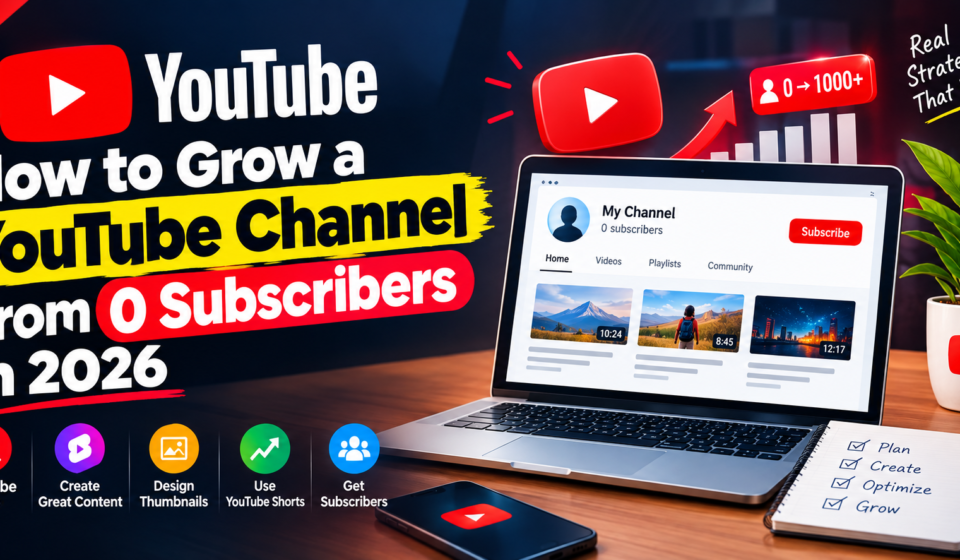

How to Grow a YouTube Channel From 0 Subscribers in 2026
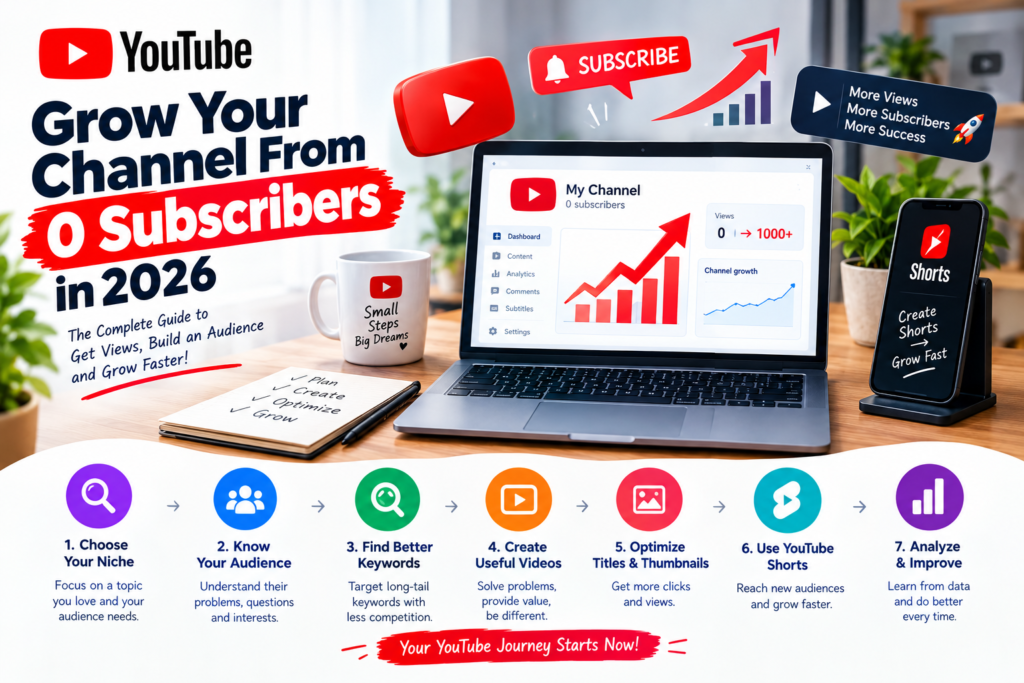
Starting a YouTube channel from zero subscribers can feel overwhelming. You upload your first video, wait for views, and sometimes nothing happens. But having zero subscribers does not mean you cannot grow. In 2026, a new YouTube channel can still build an audience by combining useful content, strong packaging, consistent publishing, audience research, and smart YouTube SEO.
The biggest mistake beginners make is focusing only on subscribers. Your first objective should be to create videos that people actually want to watch. YouTube’s search and recommendation systems use multiple signals to understand what viewers are interested in, including viewing behavior, engagement, relevance, and satisfaction.
If you are starting from zero, this guide explains exactly how to grow a YouTube channel in 2026, attract your first viewers, gain subscribers, and build a sustainable content strategy.
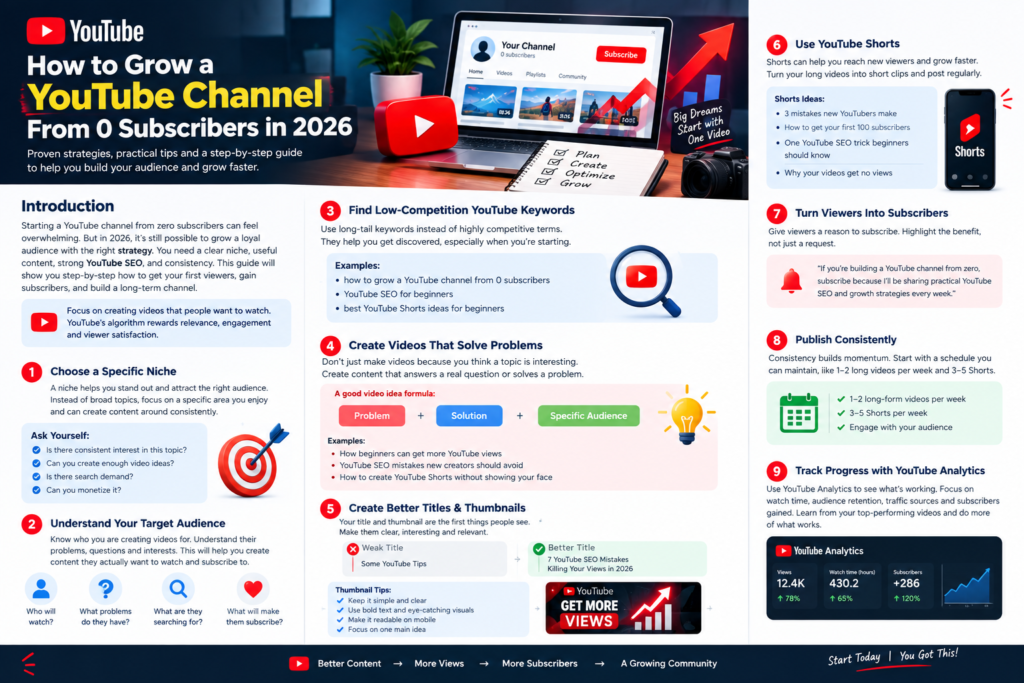
1. Choose a Specific YouTube Niche
Before uploading your first video, decide what your channel will be about.
A niche gives YouTube and your audience a clearer understanding of your content. Instead of creating random videos about technology, gaming, fitness, entertainment, and cooking, choose a specific topic and build authority around it.
For example, instead of:
- Technology
Try:
- AI tools for small businesses
- Smartphone tips for beginners
- AI productivity tools
- YouTube growth tutorials
Instead of:
- Fitness
Try:
- Home workouts for beginners
- Weight training for busy professionals
- Short workouts without equipment
A specific niche makes it easier to identify your target audience and generate related video ideas.
How to choose a profitable niche
Look for a topic that has:
- Consistent audience interest
- Enough video ideas
- Search demand
- Opportunities for monetization
- A problem you can solve
- Room for your unique perspective
Do not choose a niche only because it is popular. Choose one where you can consistently create useful content.
2. Understand Your Target Audience
One of the fastest ways to improve YouTube growth is to understand exactly who you are creating videos for.
Ask yourself:
- Who will watch my videos?
- What problems do they have?
- What questions are they searching for?
- What type of videos do they already watch?
- What would make them subscribe?
- What information can I explain better or differently?
For example, if your channel teaches YouTube SEO to beginners, your audience might search for:
- How to get YouTube views
- How to find YouTube keywords
- How to write YouTube titles
- How to make YouTube thumbnails
- How to get the first 100 subscribers
- How to grow a YouTube channel from zero
These questions can become your content calendar.
3. Find Low-Competition YouTube Keywords
YouTube SEO can help a new channel get discovered, particularly when you target specific search queries instead of extremely broad keywords.
A new channel should avoid competing immediately for keywords such as “YouTube” or “make money online.”
Instead, target long-tail phrases such as:
- How to grow a YouTube channel from 0 subscribers
- YouTube SEO for beginners
- How to get your first 100 subscribers
- How to find low competition YouTube keywords
- Best YouTube Shorts ideas for beginners
- How to get more views on YouTube Shorts
YouTube says Search considers factors including how well the title, tags, description, and video content match a viewer’s query, along with engagement and quality.
This means your keyword should naturally match what your video actually delivers.
4. Create Videos Around Problems People Want Solved
Do not create videos simply because you think a topic is interesting.
Create videos because someone has a question, problem, desire, or goal.
For example:
Weak topic:
“My YouTube Journey”
Stronger topic:
“How to Get Your First 100 YouTube Subscribers”
The second topic immediately communicates a benefit.
A useful formula for finding video ideas is:
Problem + Solution + Specific Audience
Examples:
- How Beginners Can Get More YouTube Views
- YouTube SEO Mistakes New Creators Should Avoid
- How Small Channels Can Get Their First 1,000 Subscribers
- How to Create YouTube Shorts Without Showing Your Face
The more specific the problem, the easier it can be to create a focused video.
5. Create Better YouTube Titles
Your title is one of the first things potential viewers see.
A good YouTube title should be clear, interesting, and relevant to the actual video.
Instead of:
“Some YouTube Tips”
Try:
“7 YouTube SEO Mistakes Killing Your Views in 2026”
Instead of:
“My New Channel Strategy”
Try:
“How to Grow a YouTube Channel From 0 Subscribers in 2026”
Useful title formulas include:
- How to [Achieve Result]
- [Number] Ways to [Achieve Result]
- The Beginner’s Guide to [Topic]
- How I [Result] Using [Method]
- [Topic]: Everything Beginners Need to Know
- X Mistakes That Are Killing Your [Result]
Avoid misleading clickbait. YouTube’s recommendation systems are designed to understand viewer satisfaction rather than simply reward clicks.
6. Design Thumbnails That Earn Attention
A great video can fail to attract viewers if its thumbnail does not communicate the value of the video.
Your thumbnail should be:
- Easy to understand
- Visually simple
- Relevant to the title
- Readable on mobile
- Focused on one main idea
- Different enough to stand out
Do not fill your thumbnail with paragraphs of text.
For example, a video titled:
“How to Get Your First 100 Subscribers”
could use a thumbnail concept such as:
0 → 100 Subscribers
The title and thumbnail should work together instead of repeating exactly the same information.
7. Hook Viewers Immediately
Getting someone to click is only the beginning.
You also need to give them a reason to keep watching.
Avoid spending the first 20 seconds introducing yourself, explaining your channel, or asking viewers to subscribe.
Start with the value.
For example:
“Starting from zero? In this video, I’ll show you the five steps I’d use to build a new YouTube channel from 0 subscribers.”
Then quickly move into the content.
The goal is to create a strong connection between the viewer’s expectation and the content you deliver.
YouTube’s recommendation system considers a range of signals related to viewer behavior and satisfaction, rather than relying on one simple metric.
8. Use YouTube Shorts to Reach New Viewers
YouTube Shorts can be a useful discovery tool for a new channel.
YouTube describes Shorts as a way for creators to connect with new audiences using short-form vertical videos, and Shorts can currently be up to three minutes long.
You can turn one long-form video into several Shorts.
For example, if your main video is:
“How to Grow a YouTube Channel From 0 Subscribers”
you could create Shorts such as:
- 3 mistakes new YouTubers make
- How to get your first 100 subscribers
- One YouTube SEO trick beginners should know
- How to find video ideas
- Why your YouTube videos get no views
However, don’t create Shorts purely for views. YouTube itself has emphasized that views do not automatically turn into fans; building a community requires interaction and connection with viewers.
9. Turn Viewers Into Subscribers
Getting views is useful, but building an audience is the real goal.
Give viewers a clear reason to subscribe.
Instead of simply saying:
“Please subscribe.”
Try connecting the subscription to a benefit:
“If you’re building a YouTube channel from zero, subscribe because I’ll be sharing practical YouTube SEO and growth strategies every week.”
The viewer should understand what they will receive after subscribing.
You can also create a series.
For example:
Starting a YouTube Channel From Zero — Part 1
How I Find Low-Competition Keywords — Part 2
How I Create Thumbnails — Part 3
A connected series gives viewers a reason to return.
10. Publish Consistently
Consistency does not necessarily mean uploading every day.
A sustainable schedule is better than uploading ten videos in one week and disappearing for a month.
For a beginner, you might start with:
- 1–2 long-form videos per week
- 3–5 Shorts per week
- Regular community interaction
The exact schedule depends on your available time and production ability.
The important thing is to establish a repeatable system.
Consistency also gives you more opportunities to learn which topics, formats, titles, and thumbnails perform best with your audience.
11. Analyze YouTube Analytics
Do not guess what is working.
Use YouTube Analytics to understand how viewers interact with your content.
Pay attention to:
- Views
- Watch time
- Audience retention
- Traffic sources
- Click-through rate
- Returning viewers
- Subscribers gained
- Top-performing videos
Suppose you publish ten videos and discover that three videos receive significantly more views than the others.
Don’t simply move on.
Analyze those videos.
Ask:
- What topic did they cover?
- What keyword did they target?
- What title did they use?
- What did the thumbnail communicate?
- Where did viewers discover them?
- What made viewers continue watching?
Then create more content around the successful topic.
12. Build Topic Clusters
One of the smartest strategies for a new channel is to create multiple videos around related subjects.
For example, if your channel is about YouTube growth, you could build a content cluster like this:
Main Topic: YouTube Growth
Supporting videos:
- How to Start a YouTube Channel
- How to Find YouTube Keywords
- How to Write YouTube Titles
- How to Make Better Thumbnails
- How to Get Your First 100 Subscribers
- How to Get More YouTube Views
- YouTube SEO Mistakes
- YouTube Shorts Strategy
- How to Read YouTube Analytics
This creates a library of connected content rather than a collection of unrelated videos.
13. Use Playlists to Organize Your Content
Playlists can make your channel easier to navigate.
For example:
YouTube SEO for Beginners
- Keyword Research
- Video SEO
- YouTube Titles
- YouTube Descriptions
- Thumbnail Optimization
Another playlist could be:
YouTube Growth From Zero
- Start a YouTube Channel
- Get Your First 100 Subscribers
- Get Your First 1,000 Subscribers
- Grow With Shorts
- Analyze Your Analytics
When viewers find one useful video, related content is easier to discover.
14. Promote Your Videos Outside YouTube
You do not have to depend entirely on YouTube Search.
Share useful content through platforms where your potential audience already spends time.
Depending on your niche, this might include:
- TikTok
- Quora
- Your website
- Email newsletters
But don’t spam links.
Instead, adapt the content to each platform.
For example, turn a YouTube tutorial into a short Instagram video, a LinkedIn post, a Pinterest graphic, or a detailed Quora answer.
The goal is to attract people who are genuinely interested in your topic.
15. Don’t Obsess Over Subscriber Count
When your channel has zero subscribers, every subscriber can feel important.
But constantly checking the number can distract you from improving your content.
Your first 100 subscribers are an important milestone, but your real goal should be developing a repeatable process for attracting viewers.
Think of your growth in stages:
0–100 subscribers: Learn what your audience wants.
100–1,000 subscribers: Double down on successful topics.
1,000+ subscribers: Build stronger content systems and community.
The exact speed will differ dramatically from channel to channel.
Some videos may get very few views while another video suddenly reaches a much larger audience.
16. Improve One Thing With Every Video
You don’t need your first video to be perfect.
Instead, improve one major element each time.
For example:
Video 1: Improve audio.
Video 2: Improve the introduction.
Video 3: Improve the thumbnail.
Video 4: Improve the title.
Video 5: Improve editing.
Video 6: Improve storytelling.
Video 7: Improve audience retention.
After 20–30 videos, these small improvements can produce a major difference.
17. Avoid Common YouTube Growth Mistakes
Many new creators slow their growth by making avoidable mistakes.
Uploading Random Content
If every video targets a completely different audience, it becomes harder to build a recognizable channel.
Copying Other Creators
Study successful creators, but don’t simply duplicate their videos.
Find your own angle, experience, examples, presentation, and personality.
Using Clickbait
A high-click title that fails to deliver can create a poor viewer experience.
Your title should accurately represent the video.
Ignoring Audio
Viewers may tolerate average visuals, but poor audio can make a video difficult to watch.
Giving Up Too Early
One unsuccessful video doesn’t mean your channel has failed.
You need enough data to identify patterns.
Focusing Only on Views
A video with fewer views can still attract highly relevant viewers who become loyal subscribers.
18. Create a 30-Day YouTube Growth Plan
If you’re starting from zero, here’s a simple 30-day framework.
Week 1: Research
Choose your niche.
Identify your target audience.
Research 20–30 video ideas.
Find long-tail keywords.
Study successful channels in your niche.
Create your channel branding.
Week 2: Production
Create your first 3–5 videos.
Prepare strong titles and thumbnails.
Create several Shorts from your main content.
Build playlists around your main topics.
Week 3: Publishing
Publish consistently.
Share your videos where relevant.
Respond to comments.
Monitor analytics.
Identify your strongest topics.
Week 4: Optimization
Review your best-performing videos.
Compare titles and thumbnails.
Study audience retention.
Find videos that gained subscribers.
Create follow-up videos around successful topics.
Then repeat the process.
19. Focus on Viewer Satisfaction
There is no secret button that guarantees YouTube views.
YouTube’s recommendation system uses many signals to predict what viewers are likely to find valuable, including viewing behavior, likes, dislikes, feedback, and satisfaction-related signals.
That means the most sustainable strategy is simple:
Make videos people want to watch, and make those videos worth finishing.
Don’t try to manipulate the algorithm.
Create content for humans first and optimize it for discovery second.
20. What Should You Do When a Video Gets Almost No Views?
Don’t immediately delete it.
First, investigate why.
Check:
- Is the topic interesting to your target audience?
- Does the title clearly communicate the benefit?
- Does the thumbnail stand out?
- Does the introduction deliver the promised value?
- Is the video targeting a specific search query?
- Are viewers leaving early?
- Are similar videos performing better?
- Can you create a better version of the same topic?
Sometimes the problem isn’t the entire channel. It may simply be the topic, packaging, or presentation.
21. The Best YouTube Growth Strategy for 2026
If you’re starting from zero in 2026, don’t build your entire strategy around one traffic source.
Use a combination of:
YouTube SEO + Searchable Topics + Strong Titles + Thumbnails + Long-Form Videos + Shorts + Audience Engagement + Analytics
YouTube Search emphasizes relevance, engagement, and quality, while recommendations personalize content according to viewer behavior and interests.
This means your strategy should satisfy both sides:
Search: Create content that answers specific questions.
Recommendations: Create content viewers genuinely want to watch.
Community: Give viewers a reason to return.
Analytics: Use your results to improve the next video.
Final Thoughts
Growing a YouTube channel from 0 subscribers in 2026 is possible, but it requires patience and a clear strategy. You don’t need millions of views to get started. You need your first viewer, then your first returning viewer, then your first subscriber, and eventually a community that trusts your content.
Start with a specific niche, research your audience, target long-tail keywords, create useful videos, improve your titles and thumbnails, use Shorts strategically, and study your analytics after every upload.
Most importantly, don’t wait for the perfect video.
Start creating, learn from every upload, and keep improving.
Your first 100 subscribers may take time, but the skills you develop while earning them can become the foundation for a much larger YouTube channel.