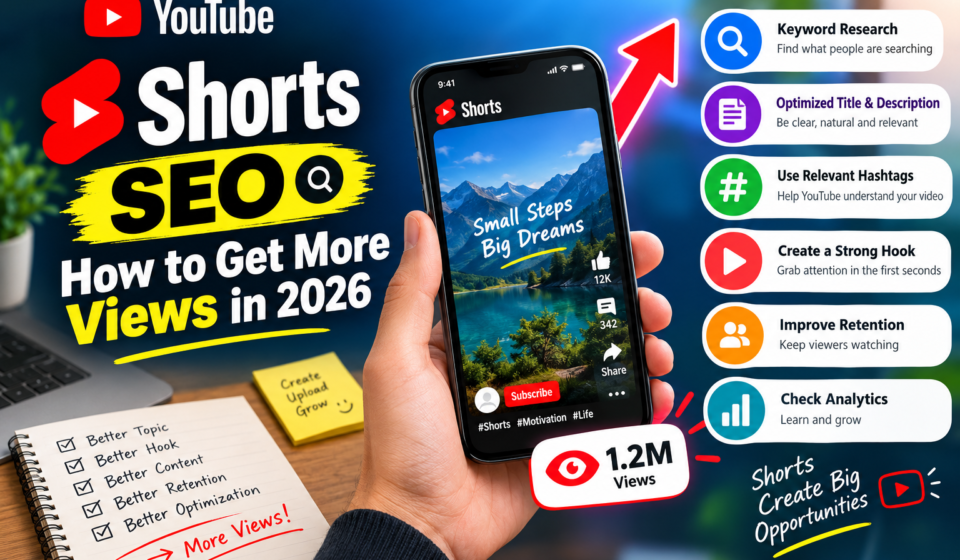

YouTube Shorts SEO: How to Get More Views in 2026
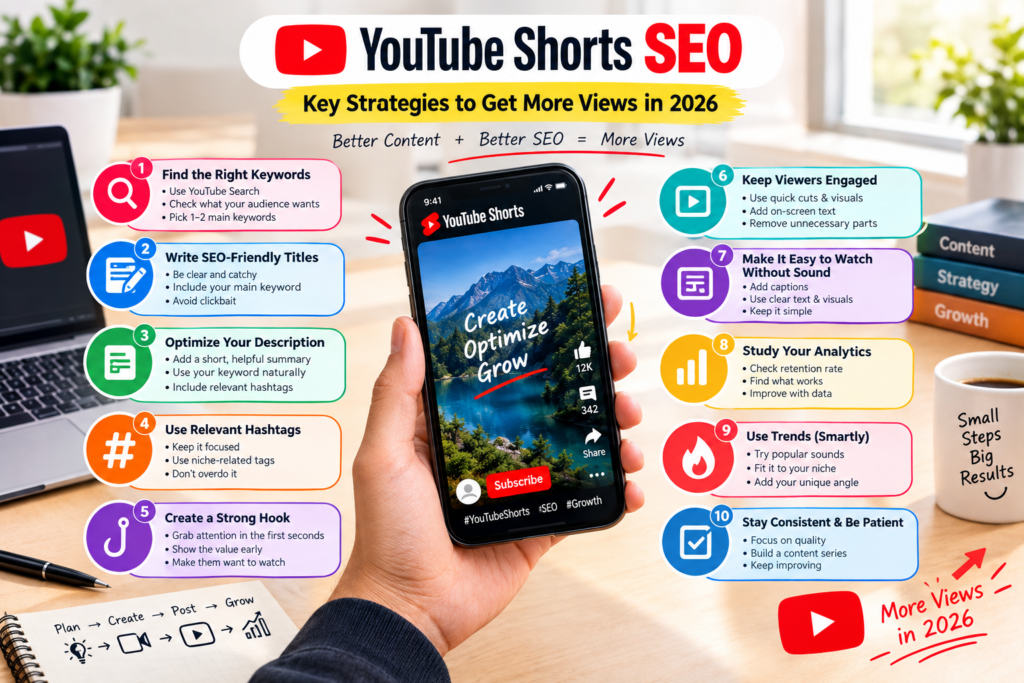
YouTube Shorts has become one of the most powerful ways to reach new viewers, build an audience, and grow a YouTube channel. But simply uploading short videos is not enough anymore. If you want more views in 2026, you need to understand YouTube Shorts SEO, audience behavior, content packaging, and performance analytics.
The good news is that you don’t need a huge subscriber base to get your Shorts discovered. YouTube says Shorts are recommended based on performance and viewer personalization rather than favoring a particular format or channel size.
In this guide, you’ll learn practical YouTube Shorts SEO strategies you can use to improve discoverability, increase viewer retention, and give your videos a better chance of reaching the right audience.
What Is YouTube Shorts SEO?
YouTube Shorts SEO is the process of optimizing your Short so that YouTube can better understand its topic and match it with viewers who are interested in that subject.
It includes factors such as:
- Keyword research
- Video titles
- Descriptions
- Relevant hashtags
- On-screen text
- Spoken keywords
- Strong opening hooks
- Viewer retention
- Engagement
- Audience satisfaction
- Content relevance
However, Shorts SEO isn’t simply about putting keywords everywhere.
YouTube’s recommendation system looks at whether viewers choose to watch a Short, whether they continue watching, and whether they enjoy it. Search also considers how well the video’s metadata matches what viewers are looking for.
That means your goal should be to create content that is searchable and genuinely interesting.
How YouTube Shorts Discovery Works in 2026
Before optimizing your Shorts, it’s important to understand where viewers can discover them.
YouTube Shorts can appear in:
- The Shorts Feed
- YouTube Search
- The YouTube Homepage
- Subscription feeds
- Channel pages
- Notifications
- External websites and apps
YouTube confirms that Shorts are ranked according to performance and personalization. For Shorts recommendations, important signals include the percentage of viewers who choose to watch, average view duration, average percentage viewed, and viewer satisfaction.
This leads to an important lesson:
SEO can help YouTube understand your video, but great viewer response is what can help your Short travel further.
1. Choose a Clear Topic Before Making the Short
One of the biggest mistakes creators make is producing random content without a clearly defined audience.
Instead, choose a specific topic.
For example, rather than making a generic Short about “money,” you could create content around:
- Personal finance tips
- Saving money
- Beginner investing education
- AI tools
- Online business
- Productivity
- Study tips
- Technology
- Fitness education
- Cooking
A focused topic makes it easier to understand what your audience wants and gives YouTube more context about your content.
YouTube recommends focusing on what your audience enjoys and using your analytics to understand which Shorts perform best.
2. Find Keywords People Actually Search For
Keyword research is an important part of YouTube SEO.
Start with a simple question:
What would someone type into YouTube if they wanted the information in my Short?
For example, if your Short teaches beginners how to save money, possible keyword ideas could include:
- how to save money
- money saving tips
- saving money for beginners
- personal finance tips
- budgeting tips
- how to budget money
Don’t try to target dozens of unrelated keywords in one video.
Instead, select one primary topic and a few closely related phrases.
YouTube itself recommends identifying one or two main words that describe a video and featuring them prominently in the title and description.
3. Write SEO-Friendly Shorts Titles
Your title should accomplish two things:
- Tell viewers what the Short is about.
- Give them a reason to watch.
Avoid stuffing the title with keywords.
For example:
Weak:
“Money Saving Tips Save Money Budgeting Personal Finance Money Tips”
Better:
“5 Simple Ways to Save More Money”
The second title is natural, clear, and easy to understand.
You can also use curiosity when appropriate:
- “You’re Probably Wasting Money on This”
- “3 Money Habits You Should Start Today”
- “This Simple Budgeting Trick Actually Helps”
Your title should accurately represent the content. YouTube says titles are an important part of how content is presented to viewers, while metadata also contributes to search relevance.
4. Optimize Your Shorts Description
Don’t ignore the description simply because Shorts are short.
Write a concise, natural description explaining what the video covers.
For example:
“Learn 5 simple money-saving tips that can help beginners build better budgeting habits and manage everyday expenses.”
You can naturally include your primary keyword once or twice.
YouTube recommends creating unique descriptions and placing one or two important words prominently in the title and description.
Avoid turning the description into a giant list of unrelated keywords.
5. Use Relevant Hashtags
Hashtags can help provide additional context about your content.
For example:
#PersonalFinance #MoneyTips #Budgeting
The important word here is relevant.
Don’t add dozens of unrelated hashtags just because they are popular.
Your hashtags should describe the actual topic of the Short.
For example, a video about budgeting doesn’t need unrelated tags simply because they are trending.
Think of hashtags as supporting information—not a substitute for good content.
6. Create a Powerful Hook in the First Seconds
The opening of your Short is extremely important.
A viewer can quickly swipe away if the video doesn’t immediately communicate why they should continue watching.
Instead of:
“Hey everyone, welcome back to my channel. Today I’m going to talk about…”
Try starting with the value:
“Stop making this common budgeting mistake.”
Or:
“Here’s a simple way to save money every month.”
The first seconds should create curiosity and immediately deliver on the promise of the title.
YouTube specifically recommends concise introductions for Shorts because the initial moments are when viewers decide whether to continue watching.
7. Improve Viewer Retention
Getting someone to start your Short is only part of the challenge.
You also want them to keep watching.
You can improve retention by:
- Removing unnecessary pauses
- Cutting repetitive sections
- Using quick visual changes
- Adding useful on-screen text
- Maintaining a clear story
- Delivering information quickly
- Creating curiosity between sections
- Ending with a satisfying conclusion
Avoid adding unnecessary information just to make the video longer.
A short, useful video can be more effective than a longer video filled with filler.
YouTube says average view duration and average percentage viewed are among the signals used to understand Shorts performance.
8. Make Your Short Easy to Understand Without Sound
Many viewers may encounter your content in different situations.
Use:
- Clear captions
- Large readable text
- Simple visuals
- Strong contrast
- Short sentences
- Visual demonstrations
Don’t put huge paragraphs on the screen.
Instead, display the most important idea.
For example:
“3 Ways to Save Money”
Then reveal each tip individually.
This makes the Short easier to follow and gives viewers another reason to stay engaged.
9. Use Keywords Naturally in Your Video
SEO isn’t limited to the title and description.
Your actual video should clearly communicate its subject.
For example, if your target topic is “YouTube Shorts SEO,” you could naturally say:
“Here are three YouTube Shorts SEO tips that can help improve your discoverability.”
You can also display the main topic as on-screen text.
The objective isn’t to repeat the keyword constantly.
The objective is to make the subject obvious.
YouTube Search considers how well metadata and video content match a viewer’s search query.
10. Focus on Audience Satisfaction
Views are important, but views alone don’t tell the complete story.
Ask yourself:
- Did viewers stay?
- Did they like the video?
- Did they comment?
- Did they share it?
- Did they subscribe?
- Did they watch another Short?
- Did the content actually answer their question?
YouTube explains that its recommendation systems consider whether viewers enjoyed the content in addition to whether they chose to watch and continued watching.
Therefore, don’t create content purely to chase clicks.
Create content that makes viewers feel that watching was worthwhile.
11. Study Your YouTube Analytics
One of the best YouTube Shorts SEO strategies is learning from your own data.
In YouTube Studio, look at your Shorts analytics and compare videos.
Useful metrics include:
- Views
- Likes
- Subscribers
- Shown in feed
- How many chose to view
- Audience retention
- Traffic sources
- YouTube Search terms
YouTube’s Shorts analytics specifically provides information such as views, likes, subscribers, shown-in-feed data, and the percentage of viewers who chose to view versus swipe away.
Your analytics can answer questions such as:
Which topics work best?
Which hooks keep people watching?
Which Shorts bring subscribers?
Which search terms are bringing viewers?
Use those answers to improve your next videos.
12. Use YouTube Search Terms for New Ideas
Your analytics can become a source of future content ideas.
YouTube Studio can show search terms that viewers used to discover your content.
Suppose your Short about budgeting gets discovered through a search related to:
“how to budget with low income”
That could become an entirely new Short.
You can turn one successful topic into several related videos:
- How to Budget on a Low Income
- 3 Budgeting Mistakes Beginners Make
- How to Create a Simple Monthly Budget
- Easy Budgeting Tips for Beginners
- How to Track Your Daily Spending
This creates a content cluster around a topic your audience has already shown interest in.
13. Don’t Obsess Over Upload Frequency
Many creators believe they need to upload several Shorts every day to succeed.
That’s not necessarily true.
YouTube states that there is no minimum posting cadence required for Shorts to perform well. It recommends finding what works for your audience and focusing on creating quality content.
Instead of asking:
“How many Shorts should I upload today?”
Ask:
“What valuable Short can I make that my audience actually wants to watch?”
Consistency is useful, but quality and audience response matter more than simply uploading for the sake of uploading.
14. Take Advantage of Trends Carefully
Trends can provide opportunities for additional discovery.
YouTube says viewers may discover Shorts through trending songs or sampled audio, and creators can use popular sounds from the Audio Library to increase their chances of appearing on sound pages.
However, don’t force every trend into your niche.
A trend should make sense for your audience.
For example, if you run a technology channel, you could adapt a trend around a technology-related topic instead of copying unrelated content.
The best approach is:
Trend + Your Niche + Your Unique Angle
15. Create Series Instead of Random Shorts
A content series can encourage viewers to watch multiple videos.
For example:
YouTube Shorts SEO Series
Part 1: Find Better Keywords
Part 2: Write Better Titles
Part 3: Improve Your Hook
Part 4: Increase Retention
Part 5: Read Your Analytics
This approach gives viewers a clear reason to return.
It can also help you explore one topic from several different angles.
16. Use Strong Storytelling
Even educational Shorts benefit from storytelling.
A simple structure is:
Problem → Curiosity → Solution
For example:
Problem:
“Your Shorts get views but almost no subscribers.”
Curiosity:
“Here’s one reason that may be happening.”
Solution:
“Your videos may be attracting viewers who aren’t interested in your broader channel topic.”
This structure gives viewers a reason to continue watching.
17. Avoid Keyword Stuffing
Keyword stuffing can make your content look unnatural.
Don’t write:
“Best YouTube Shorts SEO SEO tips YouTube Shorts views Shorts algorithm SEO 2026.”
Instead, write naturally:
“Learn practical YouTube Shorts SEO strategies to improve discoverability and attract more viewers in 2026.”
Your primary keyword should fit naturally into the content.
Remember, YouTube’s goal is to connect viewers with content they are likely to enjoy—not simply content containing the most keywords.
18. Understand the 2026 Shorts View Metric
There is an important measurement change creators should understand in 2026.
YouTube announced that beginning August 24, 2026, a public view is counted when a video begins playing across formats, including Shorts. YouTube continues to provide Engaged views in Analytics so creators can understand how many viewers chose to continue watching.
This means you shouldn’t judge a Short purely by its public view count.
Look deeper into your analytics.
Pay attention to metrics that help answer:
Did viewers actually choose to continue watching?
How long did they watch?
Did they engage?
Did the Short generate subscribers?
These measurements provide a much more useful picture of content quality.
19. Build a Repeatable Shorts SEO Workflow
You don’t need to reinvent your strategy every time.
Use a repeatable process:
Step 1: Find a Topic
Choose a topic your audience is interested in.
Step 2: Research Keywords
Find the main phrase people might search for.
Step 3: Create the Hook
Write an opening that immediately communicates the value.
Step 4: Write the Script
Keep the information focused and remove unnecessary sections.
Step 5: Record and Edit
Use clear visuals, captions, and quick pacing where appropriate.
Step 6: Optimize Metadata
Add a clear title, unique description, and relevant hashtags.
Step 7: Publish
Choose a publishing schedule that you can maintain consistently.
Step 8: Analyze
Study views, retention, engagement, traffic sources, and search terms.
Step 9: Improve
Use what you learned to create your next Short.
This turns YouTube Shorts SEO into a continuous improvement process rather than a one-time optimization task.
20. Common YouTube Shorts SEO Mistakes to Avoid
Using Clickbait That Doesn’t Match the Video
A misleading title might attract an initial view, but it can damage viewer satisfaction when the content doesn’t deliver.
Making Slow Introductions
If your important information begins too late, viewers may swipe away.
Using Too Many Hashtags
More hashtags don’t automatically mean more views.
Focus on relevance.
Copying Other Creators
Study successful content for ideas, but develop your own presentation and perspective.
Ignoring Analytics
If you don’t examine your results, you’re guessing.
Changing Your Niche Constantly
A channel that jumps randomly between unrelated subjects can make it harder to build a consistent audience.
Focusing Only on Views
Views matter, but retention, engagement, subscribers, and audience satisfaction provide additional insight.
YouTube Shorts SEO Checklist for 2026
Before publishing your next Short, check the following:
☐ Is the topic relevant to my audience?
☐ Does the Short solve a problem or provide value?
☐ Is the main keyword clear?
☐ Does the title accurately describe the video?
☐ Is the description unique?
☐ Did I use relevant hashtags?
☐ Does the opening immediately deliver value?
☐ Is unnecessary content removed?
☐ Are captions easy to read?
☐ Does the video have a clear ending?
☐ Am I using analytics to improve future Shorts?
This simple checklist can help you build a more consistent publishing process.
Final Thoughts
YouTube Shorts SEO in 2026 is about much more than adding keywords and hashtags.
The strongest strategy combines clear topics, relevant keywords, compelling hooks, strong viewer retention, useful content, and continuous analytics-based improvement.
YouTube’s own guidance makes it clear that Shorts recommendations depend heavily on performance and viewer personalization.
So don’t try to “beat the algorithm.”
Instead, create videos that make the right viewers want to stop, watch, and continue watching.
Use SEO to help YouTube understand your content. Use storytelling to capture attention. Use analytics to understand what works. Then use those insights to make your next Short better.
The formula is simple:
Better Topic + Better Hook + Better Content + Better Retention + Better Optimization = More Opportunities to Get Views
There is no guaranteed number of views for any Short, but consistently improving these areas can give your content a stronger chance of being discovered by the audience it is designed for.