
YouTube Shorts vs Long Videos: Which Is Better in 2026?
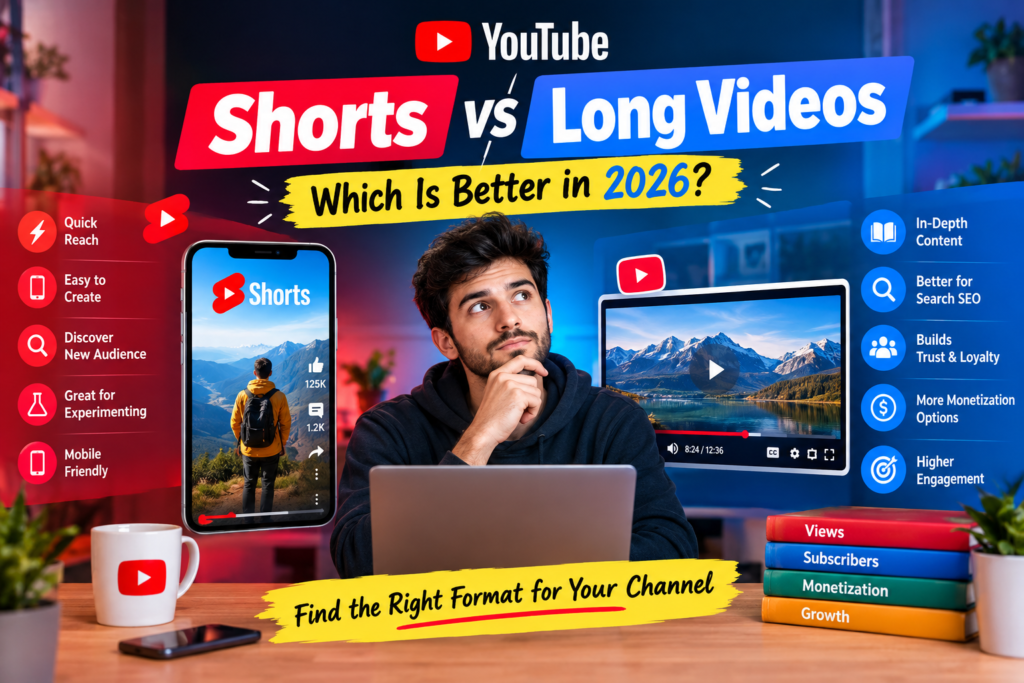
YouTube has become one of the most powerful platforms for creators, businesses, and online entrepreneurs. However, one important question continues to challenge new creators: YouTube Shorts vs long videos—which is better in 2026?
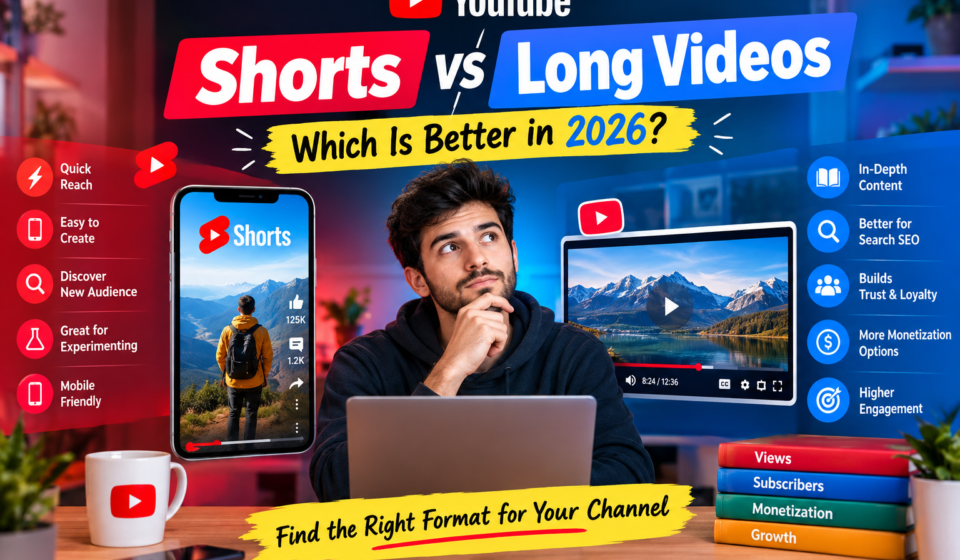
Both formats offer unique opportunities to grow an audience, increase views, build a brand, and earn money. YouTube Shorts are designed for quick, vertical content that captures attention, while long-form videos allow creators to explain topics in detail, build trust, and develop stronger relationships with viewers.
The right choice depends on your niche, goals, content strategy, and available time. In this guide, we will compare YouTube Shorts and long videos, explore their advantages and disadvantages, explain their monetization potential, and help you decide which format is best for your channel in 2026.
What Are YouTube Shorts?
YouTube Shorts are short-form videos designed primarily for mobile viewing and quick discovery. They can be created using a smartphone or editing software and are commonly presented in a vertical format.
Shorts are useful for sharing quick tips, entertaining clips, tutorials, facts, reactions, product highlights, and other content that communicates an idea quickly.
Creators can use Shorts to reach viewers who have never visited their channels. Because the format encourages quick consumption, an interesting video can attract significant attention in a short period.
Benefits of YouTube Shorts
- Potential for rapid reach: Shorts can introduce your content to viewers who do not subscribe to your channel.
- Faster production: Simple Shorts can take less time to plan, record, and edit than detailed videos.
- Easy experimentation: You can test different topics, hooks, formats, and presentation styles.
- Mobile-friendly content: Vertical videos fit naturally into the viewing habits of smartphone users.
- Audience discovery: Shorts can help you identify which topics attract interest before investing in longer productions.
However, high view counts do not automatically translate into loyal subscribers, meaningful engagement, or substantial income. Results depend on the content, audience, and how effectively you turn attention into lasting interest.
What Are Long-Form YouTube Videos?
Long-form YouTube videos are traditional videos that give creators more time to explain ideas, demonstrate processes, tell stories, or entertain an audience. They may include tutorials, reviews, interviews, educational lessons, documentaries, product comparisons, and detailed guides.
There is no single length that defines every long-form video. The ideal duration depends on the subject and how much time viewers need to receive the promised value.
For example, a quick software tip might work well in three minutes, while a complete beginner’s guide to YouTube SEO may need 10 to 20 minutes or more.
Benefits of Long-Form Videos
- Detailed explanations: You can cover complicated topics without removing important information.
- Search visibility: Helpful videos can attract viewers through YouTube search and other discovery surfaces over time.
- Audience trust: Detailed tutorials and demonstrations can establish expertise and credibility.
- Monetization opportunities: Eligible videos can earn advertising revenue, and videos that are at least eight minutes long may be eligible for mid-roll ads.
- Stronger viewer relationships: A useful video can encourage viewers to watch more content, return to your channel, or explore your recommendations.
Long-form videos often require more research, scripting, recording, and editing. Their success depends on delivering value throughout the video rather than simply making it longer.
YouTube Shorts vs Long Videos: Key Differences in 2026
Understanding the differences between both formats will help you choose the right approach for your content strategy.
| Feature | YouTube Shorts | Long-Form Videos |
|---|---|---|
| Main purpose | Quick discovery and engagement | Detailed information and deeper engagement |
| Typical format | Vertical, short-form | Usually horizontal, but other formats are possible |
| Production time | Often shorter | Often longer |
| Content depth | Focused on one idea | Suitable for comprehensive topics |
| Audience discovery | Shorts feed and other surfaces | Search, recommendations, browse, and other surfaces |
| Viewer relationship | Quick interactions and discovery | More time to build trust |
| Monetization | Shorts Feed revenue sharing for eligible creators | Watch-page ads and other eligible revenue options |
| Best content types | Quick tips, facts, highlights, short tutorials | Reviews, complete guides, lessons, interviews |
| Performance measurement | Viewed versus swiped away, retention, engagement | Impressions, click-through rate, watch time, retention |
| Best overall use | Reaching new viewers | Building depth and sustainable audience relationships |
Neither format is automatically superior. A successful strategy aligns the format with the viewer’s needs and the creator’s objectives.
1. Which Format Gets More Views?
YouTube Shorts can be effective for attracting quick attention because viewers can discover videos while scrolling through the Shorts feed. A compelling opening, clear message, and satisfying payoff can help a Short reach a wider audience.
For example, a creator teaching video editing could publish a 25-second Short showing one useful editing trick. The focused presentation may encourage viewers to watch the video and explore similar content.
Long-form videos can also generate substantial views, particularly when they answer specific questions, offer useful solutions, or entertain viewers consistently. A detailed tutorial can continue attracting search traffic long after its publication.
Winner for quick discovery: Shorts often have an advantage when the goal is to test ideas and reach new viewers quickly.
Winner for detailed, long-term content value: Long-form videos can be stronger when people actively search for a solution or want a complete explanation.
Remember that neither result is guaranteed. A weak Short may receive very few views, while an excellent long-form video can outperform many short clips.
2. Which Is Better for Getting Subscribers?
Both Shorts and long-form videos can help grow your subscriber base, but they may attract different types of viewers.
Shorts can introduce your channel to a large number of people. If viewers enjoy a quick tip or entertaining moment, some may subscribe for similar content. However, viewers who subscribe after watching one isolated clip may not necessarily be interested in your longer videos.
Long-form content gives viewers more time to understand your expertise, personality, and channel promise. When someone finds a useful tutorial or an engaging series, they may have a clearer reason to return.
To grow subscribers with Shorts:
- Focus each video on a recognizable topic or audience.
- Use a strong hook immediately.
- Deliver the promised value without unnecessary delays.
- Create related videos that viewers will want to watch next.
- Give viewers a natural reason to subscribe.
To grow subscribers with long-form videos:
- Target specific audience questions.
- Create connected tutorials or video series.
- Use clear titles and compelling thumbnails.
- Maintain consistent quality and subject relevance.
- Recommend a relevant next video when appropriate.
The best format is the one that consistently attracts the right viewers—not simply the one that produces the largest number of views.
3. Which Format Makes More Money in 2026?
Monetization is one of the biggest considerations when comparing YouTube Shorts and long videos.
Long-form videos can earn revenue through watch-page advertising, while eligible Shorts earn through the Shorts Feed revenue-sharing system. YouTube also offers other monetization features to eligible creators, depending on their location, channel status, and the applicable requirements.
How YouTube Shorts Make Money
Shorts Feed advertising revenue is handled differently from advertising on standard watch-page videos. Revenue from ads shown between Shorts is pooled, with allocations calculated under YouTube’s Shorts monetization system. Eligible creators receive 45% of the revenue allocated to them from the creator pool.
Shorts can also support other income opportunities, including sponsorships, affiliate marketing where permitted, and promoting a relevant product or service.
However, Shorts views should not be treated as a fixed amount of money. Earnings vary based on factors such as audience location, eligible engaged views, advertiser demand, music usage, and other monetization rules.
How Long-Form Videos Make Money
Eligible long-form videos can earn revenue through watch-page advertisements. Creators may also earn through memberships, sponsorships, affiliate links, merchandise, and their own products or services.
Videos that are at least eight minutes long may be eligible for mid-roll advertisements, subject to YouTube’s policies and ad-placement rules. Reaching eight minutes does not guarantee additional revenue, and creators should prioritize viewer satisfaction over unnecessary length.
Long-form videos may offer more opportunities to explain products, demonstrate expertise, and guide interested viewers toward a purchase or service.
Shorts vs Long Videos: Revenue Comparison
| Revenue factor | Shorts | Long-form videos |
|---|---|---|
| Advertising system | Shorts Feed revenue sharing | Watch-page advertising |
| Revenue per view | Often lower, but varies | Often higher, but varies |
| Mid-roll ads | Not the standard Shorts model | Available for eligible videos of at least eight minutes |
| Sponsorships | Possible | Possible |
| Affiliate marketing | Possible | Often useful for detailed recommendations |
| Product promotion | Works well for concise discovery | Allows detailed demonstrations |
Which makes more money? Long-form videos may generate more advertising revenue per view in many niches, but this is not a universal rule. Shorts can deliver considerable reach and help introduce people to a channel, product, or business.
For creators seeking sustainable income, a combination of both formats can provide a useful balance between discovery and deeper engagement.
4. Which Format Is Better for YouTube SEO?
YouTube SEO helps viewers discover content relevant to their searches and interests. Both Shorts and long-form videos can be discovered through YouTube search and other recommendation surfaces, but the format should match the searcher’s intent.
YouTube Shorts SEO
Shorts are useful for focused queries and quick answers, such as:
- How to add captions to YouTube Shorts
- One YouTube thumbnail tip
- Quick video editing tricks
- YouTube Shorts mistakes beginners should avoid
- How to write a stronger video hook
To optimize Shorts, use a descriptive title, introduce the topic clearly, and make the content relevant to the intended audience. Hashtags may help categorize content, but adding many unrelated hashtags is not a substitute for quality.
Long-Form Video SEO
Long-form videos are particularly suitable for comprehensive searches, including:
- How to start a YouTube channel from scratch
- Complete YouTube SEO tutorial for beginners
- How to grow a YouTube channel without paid advertising
- Best video editing software for YouTube creators
- How to monetize a YouTube channel
For long-form videos, research relevant search terms, create an accurate title, design a readable thumbnail, and deliver the information promised. Use descriptions and chapters where they genuinely help viewers understand and navigate the video.
YouTube does not rank videos simply because a keyword appears repeatedly. Viewer satisfaction, relevance, and performance in the context of a particular audience and query also matter.
SEO verdict: Use Shorts for concise, focused topics and long-form videos for detailed answers. Build a connected content strategy around related audience questions.
5. Which Format Is Easier for Beginners?
For many beginners, Shorts are easier to start producing because they can be recorded on a smartphone and focus on a single idea. A new creator can experiment with several hooks, editing approaches, or topics without producing a full-length tutorial every time.
For example, someone starting a channel about personal productivity could publish short videos about one time-management tip, one common mistake, or one useful app feature.
Long-form videos can be more demanding because they often require a stronger structure, better planning, and sustained audience attention. However, they can also be a better starting point when your expertise naturally involves detailed explanations.
A beginner teaching website development, for instance, may find that a complete tutorial is more useful than trying to compress every step into a 30-second clip.
My Recommendation for Beginners
Start with the format you can produce consistently without sacrificing quality. If you have limited time, experiment with Shorts first. If your niche requires explanations, demonstrations, or product comparisons, begin with long-form videos and use Shorts to highlight important points.
You do not need expensive equipment to start. Clear audio, good lighting, useful information, and a focused message are more important than elaborate production.
6. Can YouTube Shorts Help Grow Long-Form Videos?
Yes, Shorts can support a long-form content strategy, provided the content appeals to the same audience.
Imagine that you publish a 12-minute tutorial titled “How to Make Better YouTube Thumbnails.” You could create several Shorts from related ideas:
- Three thumbnail mistakes that reduce clicks
- How to improve thumbnail text readability
- One simple way to create stronger visual contrast
- A before-and-after thumbnail improvement
Each Short offers a standalone piece of value while introducing viewers to the subject covered in the full tutorial.
Where the feature is available, you can add a related video to a Short to direct viewers toward another video on your channel. This provides a more direct path than relying solely on a verbal request to visit your channel.
For the best results, make the relationship between the Short and the longer video clear. Avoid promising a solution in the Short and withholding all useful information until the full video.
7. Should You Post Shorts and Long Videos on the Same Channel?
In many cases, yes. Publishing both formats on one channel can work well when they serve the same audience and support the same overall topic.
For example, a channel about YouTube growth could publish:
- Shorts explaining individual SEO tips
- Long-form videos covering complete SEO strategies
- Shorts highlighting common creator mistakes
- Long-form tutorials showing how to fix those mistakes
This approach lets viewers discover your content in different ways while keeping the channel’s subject consistent.
However, mixing unrelated content can make it harder to develop a clear audience. A channel that posts gaming highlights, cooking tutorials, financial advice, and random comedy clips may struggle to give viewers a consistent reason to return.
YouTube does not automatically penalize a channel simply for publishing both Shorts and long videos. The more important question is whether your content meets the expectations of the people you want to reach.
If the two formats attract very different audiences, review your analytics and consider whether separate channels would make your content strategy clearer.
8. Common Mistakes to Avoid With Shorts and Long Videos
Creators sometimes focus too much on views and overlook the factors that help build a sustainable channel.
Avoid these common mistakes:
1. Chasing viral trends without a strategy
A trend may attract temporary attention, but unrelated views may not lead to a loyal audience. Choose trends that fit your niche and provide value to your target viewers.
2. Making Shorts without a strong opening
Viewers can quickly swipe to another video. Start with the central question, result, demonstration, or interesting moment rather than a lengthy introduction.
3. Making long videos unnecessarily long
Longer videos are not automatically better. Remove repetition, organize your ideas, and make every section useful.
4. Ignoring thumbnails and titles
A well-produced video can struggle to attract clicks if viewers do not understand what it offers. Make titles specific and thumbnails clear, accurate, and easy to read.
5. Using misleading clickbait
Misleading titles may create curiosity, but they can disappoint viewers and undermine trust. Make sure the video delivers what the title promises.
6. Reposting content without considering rights
Do not assume that short clips from other creators, films, television programs, or music are automatically safe to reuse. Copyright rules and YouTube’s monetization policies still apply.
7. Failing to study analytics
Review audience retention, traffic sources, engagement, and subscriber changes. For Shorts, pay attention to metrics such as viewed versus swiped away. For long videos, study impressions, click-through rate, and audience retention together rather than treating one metric as the entire story.
8. Expecting instant results
Channel growth usually requires experimentation, learning, and consistency. A video that performs poorly can still reveal which topics, hooks, or presentation styles need improvement.
9. The Best YouTube Content Strategy for 2026
Instead of choosing one format permanently, build a strategy that gives each format a clear role.
Step 1: Choose a Specific Niche
Select a topic that interests you and has a clear audience. Examples include technology tutorials, gaming, education, personal productivity, cooking, or YouTube growth.
Step 2: Research Audience Questions
Find questions that your intended viewers are already asking. Look at YouTube search suggestions, comments, competitor videos, and relevant discussions. Prioritize questions you can answer better, more clearly, or from a useful new perspective.
Step 3: Create One Detailed Video
Choose an important topic and produce a helpful long-form video if the subject requires depth. Structure it with an introduction, clear sections, practical examples, and a useful conclusion.
Step 4: Develop Related Shorts
Turn the topic into a few independent short videos. Each should deliver a useful insight on its own rather than serving as a meaningless teaser.
Step 5: Publish Consistently
Choose a schedule you can maintain. For example, you might publish one long-form video and three Shorts per week, adjusting the workload to fit your available time and resources.
Step 6: Connect Related Content
Use relevant playlists, end screens, pinned comments where appropriate, and the related-video feature for Shorts when available. Make it easy for interested viewers to find the next useful piece of content.
Step 7: Review Performance and Improve
After publishing several videos, identify which topics generate meaningful engagement, returning viewers, and subscribers. Use the findings to improve future content rather than copying another creator’s schedule blindly.
Consistency is valuable, but it does not mean posting as frequently as possible. Sustainable quality is more useful than publishing large amounts of content that does not serve your audience.
10. How to Measure Success for Each Format
The right metrics depend on the goal of your content.
For Shorts, examine:
- Viewed versus swiped away: Helps show how often viewers choose to continue watching rather than move on.
- Audience retention and average view duration: Helps reveal whether the Short holds attention.
- Engaged views: Provides additional context about meaningful viewing activity under YouTube’s reporting definitions.
- Subscribers gained: Helps assess whether the content attracts people who want more.
- Shares and comments: Can indicate that viewers found the content useful, entertaining, or worth discussing.
For long-form videos, examine:
- Impressions: Shows how often YouTube displays your thumbnail in eligible contexts.
- Click-through rate: Helps evaluate how frequently impressions lead to views.
- Average view duration: Shows how long people watch on average.
- Audience retention: Reveals where viewers remain interested or leave.
- Returning viewers: Helps you understand whether people come back to your channel.
- Subscribers and relevant conversions: Shows whether the video supports your wider goals.
Compare videos with similar topics, lengths, and traffic sources when possible. One video’s performance does not establish a universal rule about which format is better.
Frequently Asked Questions
Are YouTube Shorts better than long videos in 2026?
Shorts can be better for quick discovery, experimentation, and concise content. Long videos can be better for detailed education, product reviews, and building deeper viewer relationships. The right choice depends on your goals and audience.
Do YouTube Shorts get more views than long videos?
Shorts can receive rapid exposure through the Shorts feed, but performance varies. Long-form videos can attract substantial traffic through search, recommendations, and returning viewers. Neither format guarantees more views.
Do long YouTube videos make more money than Shorts?
Long-form videos may earn more advertising revenue per view in many situations, but earnings depend on the audience, niche, advertiser demand, eligibility, and other factors. Shorts use a different revenue-sharing system, so direct comparisons are not always straightforward.
Should beginners start with Shorts or long videos?
Beginners can start with either format. Shorts are useful for testing ideas with relatively simple production, while long videos are useful when the topic needs a detailed explanation. Choose the format that best serves your audience and available resources.
Can I monetize a channel that publishes only Shorts?
Yes. Eligible channels can monetize Shorts through YouTube’s applicable partner and Shorts monetization systems. They must meet the relevant eligibility requirements and comply with YouTube’s policies.
Do Shorts subscribers watch long-form videos?
Some do, especially when both formats cover related subjects for the same audience. However, subscribing after watching a Short does not guarantee that someone will watch your longer videos.
How many Shorts should I post per day?
There is no universal ideal number. Start with a manageable schedule, maintain quality, and use your analytics to determine whether posting more often improves results.
Is it better to use separate channels for Shorts and long videos?
Usually, one channel is a reasonable starting point when both formats target the same audience. Separate channels may make sense when the subjects, viewer expectations, or brand identities are substantially different.
Conclusion: YouTube Shorts vs Long Videos—Which Is Better in 2026?
The answer to YouTube Shorts vs long videos in 2026 depends on what you want to achieve. Shorts are valuable for discovery, quick tips, testing ideas, and reaching new viewers. Long-form videos are valuable for detailed explanations, search-focused tutorials, audience trust, and a wider range of monetization opportunities.
For many creators, the strongest strategy is to use both formats together. Publish useful long-form content when a topic needs depth, then create related Shorts that deliver individual insights and introduce the topic to new viewers.
Start with a clear niche, understand your audience, focus on quality, and measure your results. Rather than chasing every trend, build a channel that consistently gives viewers a reason to watch, subscribe, and return.
The best format is not necessarily the one with the most views—it is the one that helps you reach the right audience and achieve your channel’s goals.