
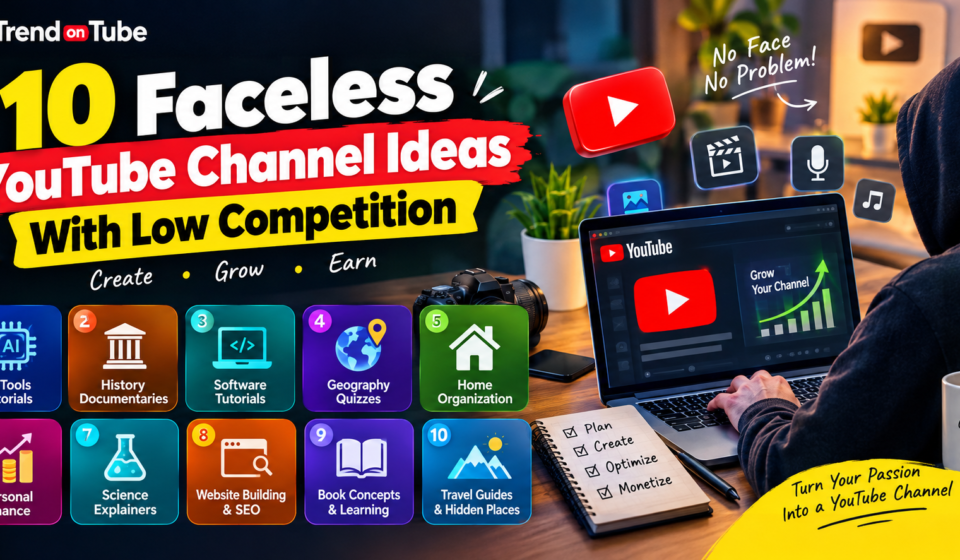

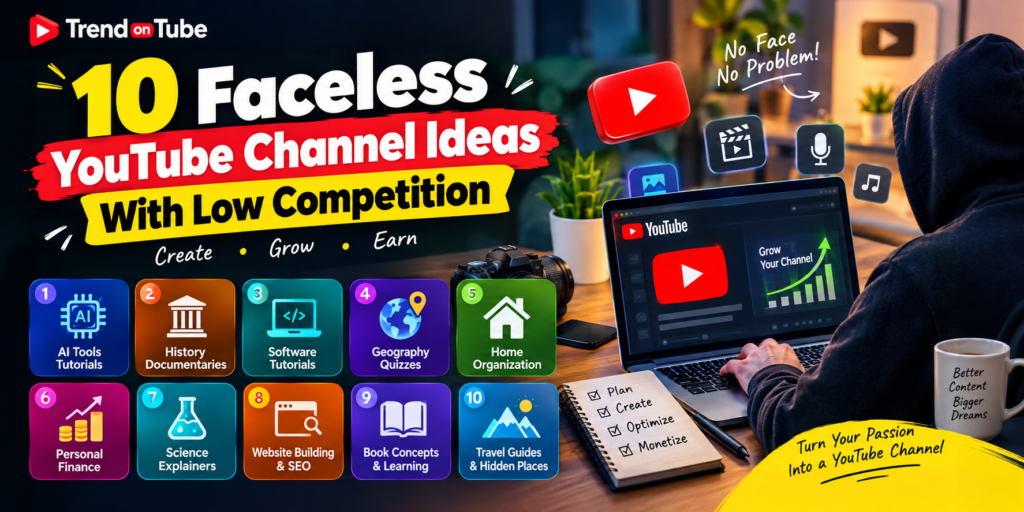
10 Faceless YouTube Channel Ideas With Low Competition in 2026
Starting a YouTube channel without showing your face has become an attractive option for aspiring content creators. You can share knowledge, tell engaging stories, create tutorials, and build an audience using voiceovers, screen recordings, animations, and original visuals. The best part is that you do not need an expensive camera setup or a studio to get started.
However, choosing the right niche is one of the most important steps toward building a successful channel. Popular categories such as gaming, motivation, and general facts already have many established creators. Instead of competing directly with them, beginners can explore specific topics that serve smaller, clearly defined audiences.
In this guide, we will explore 10 faceless YouTube channel ideas with low competition that you can consider in 2026. You will also learn how to create content for each niche, find potential viewers, and build a channel with long-term growth opportunities.
What Is a Faceless YouTube Channel?
A faceless YouTube channel is a channel where the creator does not appear on camera. Instead, videos rely on narration, animations, screen recordings, demonstrations, illustrations, gameplay, or other visuals to communicate information.
For example, you could create software tutorials by recording your computer screen, explain historical events using maps and illustrations, or publish educational videos featuring animated diagrams.
Faceless channels can cover almost any subject. Their success depends on the usefulness, originality, presentation, and appeal of their content rather than whether the creator appears on screen.
1. AI Tools Tutorials for Specific Professions
Artificial intelligence is changing how people work, study, and create content. While broad AI tutorial channels can be competitive, focusing on a particular profession or task can help you reach a more specific audience.
Instead of covering every new AI tool, build a channel around practical tutorials for a clearly defined group of people.
Video ideas:
- Best AI Tools for Bloggers and SEO Writers
- How to Use AI to Create YouTube Thumbnails
- AI Tools for Small Business Owners
- How Teachers Can Use AI to Prepare Lessons
- Free AI Tools for Freelancers in 2026
How to create videos: Record your screen while demonstrating tools, explain each step with a voiceover, and show the final result. Include real examples rather than simply listing features.
Monetization opportunities: Depending on eligibility and the products you cover, potential revenue sources include YouTube advertising, software affiliate programs, sponsorships, and digital guides.
Why consider this niche? Viewers often search for solutions to specific problems. A tutorial that helps a freelancer complete one task may be more useful than a general video discussing dozens of AI tools.
2. Micro-Niche History Documentaries
History is an evergreen subject with plenty of storytelling opportunities. However, general history documentaries compete with established educational channels. A more focused approach can help a new creator develop a recognizable identity.
Consider covering overlooked historical events, forgotten inventions, abandoned settlements, unusual engineering projects, or the history of everyday objects.
Video ideas:
- The Forgotten Invention That Changed Modern Life
- Why Some Ancient Cities Were Abandoned
- The History of the World’s Oldest Bridges
- How People Sent Messages Before the Internet
- The Rise and Fall of a Forgotten Empire
How to create videos: Combine carefully researched scripts with maps, archival photographs, diagrams, illustrations, and narration. Use visuals you own, have permission to use, or can legally license.
Monetization opportunities: Advertising, educational sponsorships, relevant book affiliate links, and other eligible partnerships may provide revenue opportunities.
Why consider this niche? Historical stories can remain relevant for years. Narrowing your focus to a specific era, region, or type of historical event can help differentiate your videos.
3. Practical Software Tutorials for Beginners
Many people want to learn software without enrolling in expensive courses. This creates opportunities for creators who can explain digital tools in a simple, beginner-friendly way.
Rather than creating tutorials about every application, choose one audience or software category and solve common problems.
Video ideas:
- How to Create a Professional CV in Canva
- Excel Formulas Every Beginner Should Know
- How to Design Social Media Posts for Free
- WordPress SEO Settings Explained for Beginners
- How to Edit Videos Using Free Desktop Software
How to create videos: Use screen recordings, zoom in on important controls, add captions, and demonstrate each step. Make sure your instructions match the software’s current interface.
Monetization opportunities: Software affiliates, sponsored tutorials, templates, downloadable resources, and YouTube advertising can all be potential options.
Why consider this niche? Tutorials that solve specific problems can attract viewers through YouTube Search. They can also continue receiving views long after publication when the information remains accurate.
4. Geography Quizzes and Visual Learning
Quiz channels can be created without showing your face, using maps, graphics, text, and narration. Geography is especially suitable because it offers countless topics that can be turned into interactive challenges.
To stand out, avoid relying exclusively on generic trivia. Create themed quizzes with increasing difficulty and clear educational value.
Video ideas:
- Can You Identify These Countries by Their Shapes?
- Guess the Country From Three Clues
- Can You Name All 50 US States in Five Minutes?
- World Capitals Quiz for Beginners
- Guess the Country From Its Flag
How to create videos: Design your own maps and question slides, add a countdown timer, and reveal the correct answer after each question. Short quizzes can work well for Shorts, while longer challenges can encourage viewers to play along.
Monetization opportunities: YouTube advertising, educational partnerships, printable quiz packs, and other relevant products may provide opportunities.
Why consider this niche? Interactive videos encourage viewers to participate rather than passively watch. You can also build recurring series around countries, flags, capitals, landmarks, and world geography.
5. Home Organization for Small Spaces
Home organization is a practical niche that can be filmed without revealing your face. You can demonstrate storage solutions using hands-only footage, overhead shots, before-and-after comparisons, and simple diagrams.
A narrower focus, such as organizing small apartments, compact bedrooms, or home offices, may help you attract a specific audience.
Video ideas:
- 10 Storage Ideas for Small Bedrooms
- How to Organize a Tiny Home Office
- Budget-Friendly Kitchen Organization Ideas
- Small Closet Organization for Beginners
- DIY Desk Organization Ideas for Students
How to create videos: Film your own demonstrations, explain the problem and solution, and show the finished arrangement. You can also create original illustrated layouts when filming is not practical.
Monetization opportunities: Home-product affiliate links, sponsorships, printable organization planners, and advertising are possible options.
Why consider this niche? Viewers often look for practical solutions they can implement immediately. Useful demonstrations also give you opportunities to create seasonal content and recurring series.
6. Personal Finance Basics for Beginners
Personal finance is a broad niche, but beginner-focused educational content can address specific questions that people encounter in everyday life.
Rather than making unsupported claims about investments or promising quick wealth, concentrate on budgeting, saving, financial terminology, and responsible money management.
Video ideas:
- How to Create a Monthly Budget From Scratch
- Needs vs. Wants: A Simple Money Management Guide
- How Compound Interest Works for Beginners
- Common Budgeting Mistakes to Avoid
- How to Build an Emergency Fund Step by Step
How to create videos: Use animated charts, spreadsheet demonstrations, simple examples, and clear narration. Explain assumptions behind calculations and distinguish general education from personalized financial advice.
Monetization opportunities: Advertising, relevant financial education products, sponsorships, and carefully selected affiliate partnerships may be available.
Why consider this niche? Financial education can attract viewers looking for solutions to recurring problems. However, the broad category is competitive, and trust is especially important. Accurate research and transparent explanations should be your priorities.
7. Science Experiments and Everyday Explanations
Science content does not always require a laboratory or an on-camera presenter. Many everyday questions can be answered using original animations, demonstrations, diagrams, and carefully sourced visual material.
You can specialize in explaining ordinary phenomena in a simple and entertaining way.
Video ideas:
- Why Does Metal Feel Colder Than Wood?
- How Do Airplanes Stay in the Sky?
- Why Does the Moon Change Shape?
- How Do Solar Panels Generate Electricity?
- What Happens Inside a Microwave Oven?
How to create videos: Write a clear question-driven script, explain the science accurately, and support your explanation with diagrams or demonstrations. Cite credible sources when discussing technical or scientific claims.
Monetization opportunities: YouTube advertising, educational sponsorships, science-related affiliate products, and downloadable learning materials may be suitable.
Why consider this niche? Everyday science combines curiosity with educational value. It can also support both short explanatory videos and longer, detailed lessons.
8. Website Building and SEO for Small Businesses
Website building and search engine optimization are useful skills for entrepreneurs, bloggers, freelancers, and small business owners. A faceless channel can teach these topics through screen recordings, website examples, and practical walkthroughs.
Instead of competing for broad keywords such as “SEO tips,” focus on specific tasks and audiences.
Video ideas:
- How to Write SEO-Friendly Blog Titles
- WordPress SEO for New Bloggers
- How to Submit a Sitemap to Google
- How to Improve Website Speed on a Budget
- Basic SEO Checklist for Small Business Websites
How to create videos: Demonstrate each task on a test website, explain the reasoning behind your recommendations, and use current screenshots. Avoid promising guaranteed rankings because search results depend on many factors.
Monetization opportunities: Hosting and software affiliates, website templates, SEO checklists, digital products, client leads, and eligible advertising revenue.
Why consider this niche? Practical tutorials can attract viewers who want to complete a task or improve an existing website. They can also connect naturally with related content about blogging, content marketing, and website management.
9. Book Concepts and Practical Learning Summaries
Some viewers want to understand complex ideas without reading multiple books on the same subject. A channel can explain broad concepts from psychology, productivity, business, communication, and personal development.
The key is to add your own interpretation, examples, analysis, and practical applications rather than simply reading books aloud.
Video ideas:
- Five Practical Lessons About Building Better Habits
- How to Improve Focus When Working From Home
- Why Small Daily Improvements Matter
- Simple Ways to Make Better Decisions
- Productivity Principles for Busy Students
How to create videos: Develop original scripts, use simple illustrations, and explain concepts through everyday situations. Credit authors and sources appropriately, and respect copyright when discussing or quoting published material.
Monetization opportunities: Book affiliate links, educational products, sponsorships, and YouTube advertising may be possible.
Why consider this niche? Educational concepts can support a large library of related videos. A focused angle, such as productivity for students or communication for freelancers, can make the channel more distinctive.
10. Local Travel Guides and Hidden Places
Travel channels do not have to feature a presenter speaking to the camera. You can produce useful travel content with original location footage, maps, narrated itineraries, and practical planning information.
One potential approach is to cover a specific city, region, or type of destination rather than trying to cover the entire world.
Video ideas:
- Best Budget-Friendly Places to Visit in Lahore
- Hidden Historical Places Worth Exploring in Pakistan
- How to Plan a One-Day Trip on a Budget
- What to Know Before Visiting Northern Pakistan
- A Beginner’s Guide to Public Transport in a Major City
How to create videos: Film places yourself when possible, create original maps, and explain travel times, budgets, seasonal considerations, and practical tips. Verify information such as opening hours and transport options before publishing.
Monetization opportunities: Travel-related affiliate programs, accommodation partnerships, local business sponsorships, downloadable itineraries, and eligible advertising revenue.
Why consider this niche? Localized content can be more specific than generic travel videos. It may also help you build an audience interested in a particular destination or region.
Comparison of the 10 Faceless YouTube Niches
The following table compares these ideas by production approach and relative starting difficulty. These are practical estimates, not measured keyword-competition scores.
| Niche | Main Video Format | Starting Difficulty |
|---|---|---|
| AI tool tutorials | Screen recordings | Easy–Medium |
| Micro-niche history | Narration and illustrations | Medium |
| Software tutorials | Screen recordings | Easy–Medium |
| Geography quizzes | Graphics and animations | Easy |
| Home organization | Hands-only demonstrations | Medium |
| Personal finance basics | Charts and narration | Medium |
| Everyday science | Diagrams and demonstrations | Medium |
| Website building and SEO | Screen recordings | Easy–Medium |
| Book concepts and learning | Narration and illustrations | Medium |
| Local travel guides | Location footage and maps | Medium–High |
The easiest niche for you will depend on your skills, available equipment, research ability, and preferred video format. A simple screen-recording channel may be easier to produce than a documentary channel requiring extensive research and editing.
How to Find Low-Competition Keywords for a Faceless YouTube Channel
Choosing a promising niche is only the first step. You also need video topics that people want to watch and that your channel can realistically compete for.
Use the following process to research keywords before publishing.
1. Start With a Specific Topic
Avoid beginning with a broad keyword such as “AI,” “history,” or “SEO.” Add a clear audience, problem, or outcome.
For example:
- Broad: SEO
- More specific: WordPress SEO for beginners
- More specific still: How to Submit a WordPress Sitemap to Google
The narrower phrases may reveal more focused search intent, although you still need to check actual competition.
2. Use YouTube Search Suggestions
Type your main topic into YouTube’s search box and review the suggested phrases. These can provide ideas for related searches and common ways viewers describe their questions.
Create a list of relevant suggestions and turn them into potential video topics.
Remember that search suggestions are idea sources, not proof of search volume or low competition.
3. Analyze Competing Videos
Search for your proposed title and examine the videos already ranking for that query.
Consider these questions:
- Are the top results from large, established channels?
- Are smaller channels receiving meaningful views?
- Do existing videos answer the question clearly?
- Could you provide a more detailed, updated, or easier-to-follow explanation?
- Are viewers asking unanswered questions in the comments?
A smaller channel receiving unusually strong views can be a useful signal of audience interest, but one successful video does not guarantee that the entire niche is easy to enter.
4. Validate Keywords With Research Tools
You can use tools such as Google Trends, YouTube autocomplete, and YouTube-focused keyword research platforms to explore related topics and compare interest.
Look for phrases that match your audience and the content you can produce consistently. Where search-volume or competition metrics are available, treat them as estimates rather than exact measurements of your chances of ranking.
5. Build a Cluster of Related Videos
Once you identify a useful topic, plan several connected videos around it.
For example, a channel about AI tools for bloggers could publish:
- Best Free AI Tools for Bloggers
- How to Use AI for Keyword Research
- How to Create a Blog Outline With AI
- AI Writing Mistakes Bloggers Should Avoid
- How to Edit AI-Assisted Content for Better Quality
Related videos help you develop subject expertise and give viewers a reason to watch more than one video.
How to Start a Faceless YouTube Channel in 2026
After choosing a niche, follow a simple launch plan instead of spending weeks searching for the perfect idea.
Step 1: Define your target audience. Decide who your videos will help and what problems you will solve.
Step 2: Choose a repeatable format. Pick screen recordings, original animation, narration, hands-only demonstrations, or another format you can produce regularly.
Step 3: Research your first 10 topics. Prioritize specific questions and useful video ideas rather than selecting topics based only on viral potential.
Step 4: Write original scripts. Organize each video around a clear promise, a strong introduction, useful information, and a satisfying conclusion.
Step 5: Create original or properly licensed visuals. Use your own footage, screen recordings, graphics, animations, and appropriately licensed media. Check the licensing terms before using third-party assets.
Step 6: Optimize titles and thumbnails. Make the subject immediately clear and give viewers an accurate reason to click. Avoid misleading claims and excessive clickbait.
Step 7: Review performance. Monitor impressions, click-through rate, audience retention, comments, and returning viewers where available. Use these signals to improve your next videos.
You do not need to publish every day. A realistic schedule that allows you to maintain quality is generally more sustainable than a high-volume schedule that causes you to rush your content.
Can Faceless YouTube Channels Be Monetized in 2026?
Yes. A channel does not need to show the creator’s face to qualify for YouTube monetization. However, faceless content must still meet the applicable YouTube Partner Program requirements and monetization policies.
Originality is particularly important. Repetitive, mass-produced, or minimally transformed content may be ineligible for monetization, even when it uses AI tools or royalty-free visuals. You should check YouTube’s current official policies before building your production process around automated videos.
AI can help with brainstorming, research organization, captions, editing, and other production tasks. However, it should support your creative work rather than replace meaningful input. Add original explanations, demonstrations, storytelling, or analysis to every video.
If a video contains realistic altered or synthetic content that falls within YouTube’s disclosure requirements, use the appropriate disclosure. Also, ensure that your visuals, music, and voice assets comply with copyright and licensing rules.
For the latest requirements, consult the official YouTube Partner Program overview and YouTube’s channel monetization policies.
Common Mistakes to Avoid When Starting a Faceless Channel
Even a promising niche can struggle if the content lacks a clear purpose or consistent quality.
Choosing a niche only because it seems profitable: High earning potential does not guarantee low competition, views, or revenue. Choose a subject you can research and produce well.
Copying successful channels: Use competitors for research and inspiration, but develop your own scripts, visuals, structure, and point of view.
Relying entirely on automated videos: Automatically generated scripts and repetitive visuals can produce generic results. Review everything and add meaningful original value.
Ignoring thumbnails and titles: A useful video still needs clear packaging. Communicate its main benefit without exaggerating what it delivers.
Publishing without checking performance: Use audience feedback and analytics to understand what works, then improve your approach.
Expecting instant results: Building an audience usually requires experimentation and patience. No niche guarantees viral views, rapid subscribers, or monetization.
Final Thoughts
Starting a faceless YouTube channel in 2026 can be a practical way to share knowledge, develop creative skills, and build an online audience without appearing on camera. The best opportunity is not necessarily the most popular niche. It is a focused subject where you can offer something useful, produce original videos consistently, and serve an audience with clear interests.
Among these 10 ideas, AI tool tutorials, beginner-friendly software guides, geography quizzes, and website-building tutorials are worth exploring if you want to start with relatively accessible production methods. History documentaries, science explainers, and local travel guides can also work well if you enjoy research and storytelling.
Before committing, research the competition, outline at least 10–20 potential videos, and create a few test videos to evaluate your workflow. Choose the niche that best balances audience demand, manageable production, and your ability to deliver genuine value.
A successful faceless channel is built through useful content and consistent improvement—not simply by finding a supposedly secret low-competition niche.